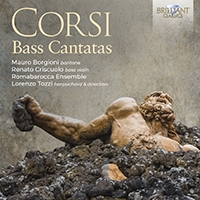
Corsi: Bass Cantatas
12,00 €
Formát:
CD
Dostupnosť:
7-14 dní
Katalógové číslo:
96693
EAN kód:
5028421966939
Autori:
Giuseppe Corsi Da Celano
Interpreti:
Lorenzo Tozzi, Mauro Borgioni, Renato Criscuolo, Romabarocca Ensemble
Vydavateľ:
BRILLIANT CLASSICS
Zoznam skladieb
Dalle balze sicane (Encelado), TriCo 581 I. (Recitativo) “Dalle balze sicane”
2 II. Aria. “Giove tiranno”
3 III. (Recitativo). “Anneriscon le sfere”
4 IV. Aria. “Cieli ingrati”
5 V. (Recitativo). “Disseta pur lo sdegno”
6 VI. Aria. “Li ciechi abissi”
7 VII. (Recitativo). “Tacete, alme”
8 VIII. Aria. “Agl’urli tremanti”
9 IX. Aria. “Son sorde a danno mio”
Cruda legge del mio fato, TriCo 57
10 I. Aria. “Cruda legge del mio fato”
11 II. Aria. “Mi stracciano le pene”
12 III. (Recitativo). “Ma non lice al mio core”
13 IV. Aria. “Se con note di gioia”
14 V. (Recitativo). “Ed in stato infelice”
15 VI. Aria. “Così confondano”
16 VII. (Recitativo). “Pianger non posso”
17 VIII. Aria. “Cruda legge”
18 IX. (Recitativo e aria). “Or s’è pena il tacere”
Partitas on Different Sonatas, Suite No. 1
19 I. Toccata
20 II. Ruggiero per la lettera B
21 III. Bergamasca per la lettera B
22 IV. Chiacona per la lettera B
23 Me lo volete dire? TriCo 63a
Abbandonato e solo (il Nerone), TriCo 49
24 I. (Recitativo) “Abbandonato e solo”
25 II. Aria. “Quella morte che per gioco”
26 III. (Recitativo). “Ma che miro!”
27 IV. Aria. “Vieni pur”
28 V. (Recitativo). “Ma no. Merta Nerone”
29 VI. Aria. “Contro l’armi dell’inganno”
Partitas on Different Sonatas, Suite No. 2
30 I. Capritio sopra otto figure
31 II. Capritio sopra li cinque tempi
32 III. Passa galli per la lettera E
Pompe voi che ascondete
33 I. (Recitativo) “Pompe, voi che ascondete”
34 II. Aria. “Perch’io tema bastanti voi siete
35 III. Aria. “Nel profondo cieco mondo”
Popis
Giuseppe Corsi (c.1631/1691), known as Celani, was one of the most important composers of the Roman school active in the second half of the 17th century. Little is known about his origins although, according to historian Pietro Antonio Corsignani, his family belonged to the noble branch of the Evangelisti Corsi family. Born in Abruzzo, he soon moved to Rome to undertake his musical studies, enjoying employment as maestro di cappella in several cathedrals and basilicas in the Italian capital and further afield. Later, during his exile from the Papal State, Corsi had Perti as his pupil, later conducting several of the latter's sacred compositions. Corsi's catalogue of works includes around 23 secular compositions including Cantatas for one voice and basso continuo (TriCo 49–69). The protagonist of the cantata Dalle balze sicane (TriCo 58) is the mythological Enceladus who, having been plunged into the bowels of Mount Etna by the goddess Athena, invokes Jupiter to placate the outrage against him. The character’s 'misfortunes' and 'sorrows' of love in Cruda legge del mio fato (TriCo 57) find analogies with those experienced by the composer. The first aria in this cantata is rich in complex enharmonics, greatly expanded and varied in the repeat, when the voice is engaged in difficult bravura passages. The cantata Abbandonato e solo (TriCo 49) begins with a veritable monologue from Roman emperor Nero, tormented by his past ghosts. The cantata on this album by Giacomo Antonio Perti (1661–1756), Pompe, voi che ascondete, although attributed to Corsi’s favourite pupil, is in fact still of unproven authorship. It is possible that Giuseppe Corsi met Giovanni Battista Vitali (1632–1692). The two composers in 1685 took part in the famous dispute over parallel fifths in Arcangelo Corelli's Sonata Op.2 No.3. The bass of the violin family, of which Vitali was a virtuoso, was widespread thanks to the Este patronage of Duke Francesco I. Called violone or bass, it would soon evolve into the violoncello thanks to the invention of coated strings that made it possible to reduce the size of the instrument. In his cantatas, Corsi repeatedly insists on the B flat grave, a characteristic of violin bass tuning, and the numerous semiquaver passages are particularly agile on the violone, so it is not unlikely that the composer from Marsica had this instrument in mind. It is also for this reason that Corsi's compositions have been joined by some movements from the Partite sopra diverse sonatas for the violone by Vitali that are particularly pleasing.