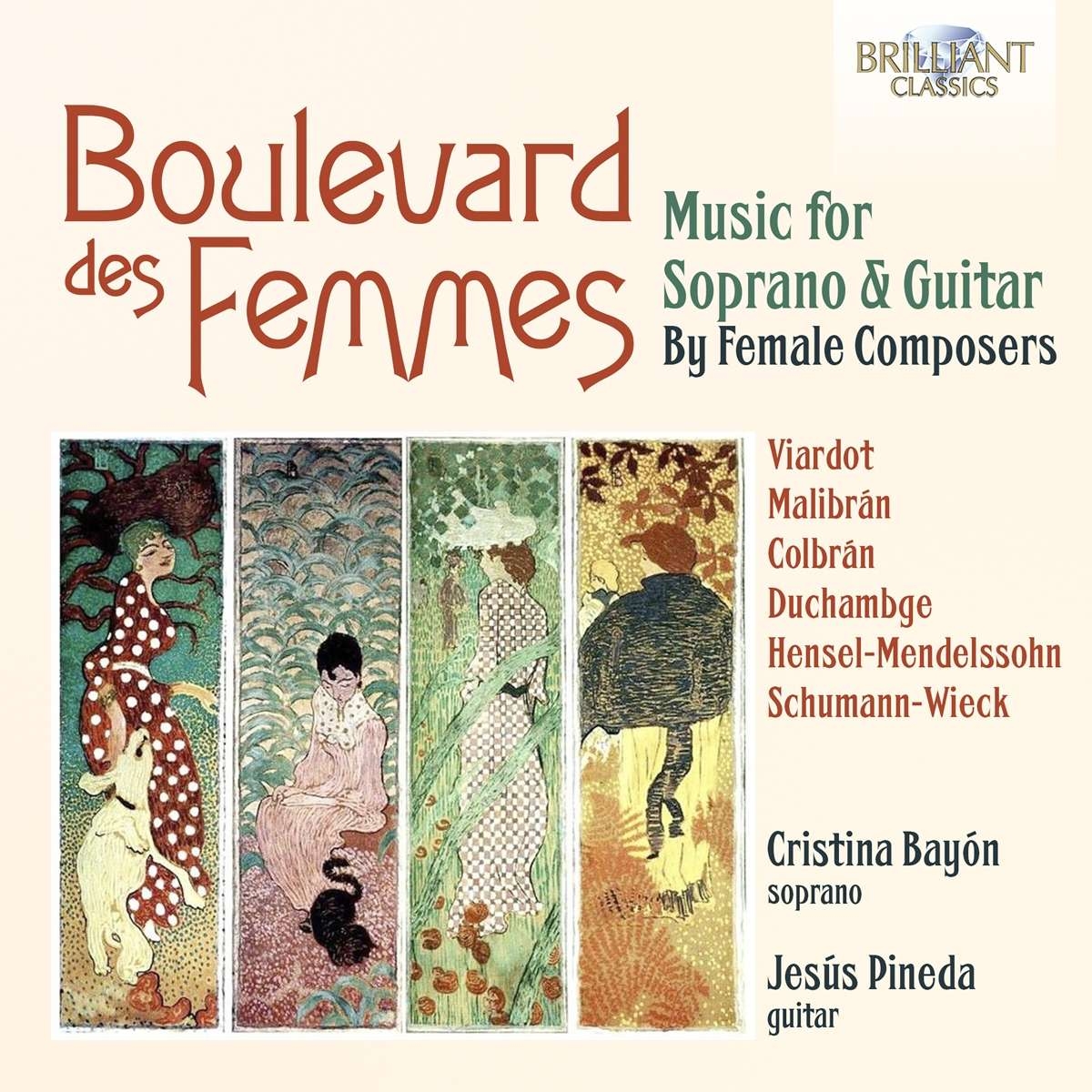
Music for Soprano & Guitar by Female Composers
12,00 €
Formát:
CD
Dostupnosť:
backorder/ dodacia doba 7-14 dní
Katalógové číslo:
96729
EAN kód:
5028421967295
Autori:
Clara Schumann, Fanny Mendelssohn, Isabella Colbrán, Maria Malibran, Pauline Duchambge, Pauline Viardot-Garcia
Interpreti:
Cristina Bayón, Jesús Pineda
Vydavateľ:
BRILLIANT CLASSICS
Zoznam skladieb
Pauline Viardot Garcia1 6 Mélodies et une havanaise: IV. Hai Luli! VWV 1106
2 6 chansons du XVe siècle: I. Aimez-moi ma mignonne, VWV 1121
3 10 Mélodies: III. L’Absence-Caña Española, VWV 1046
4 6 Mélodies: V. Madrid, VWV 1136
5 Lamento- La chanson du pêcheur, VWV 1139
6 6 Mélodies: VI. Les filles de Cadix, VWV 1135
María Malibrán
7 Le retour de la Tyrolienne in B-Flat Major
8 La voix qui dit: je t’aime in A Major
9 La bayadère
Isabella Colbrán: 6 Petits airs italiens:
10 XIV. Quel cor che mi prometti
11 XII. Mi lagnerò tacendo
12 III. Benchè ti sia crudel
Pauline Duchambge
13 Celle qui voudrait m’aimer
14 Guitare
15 Le bouquet de bal
Fanny Mendelssohn
16 12 Lieder, Op. 9: I. Die None
17 6 Lieder, Op. 1: I. Schwanenlied
Clara Schumann
18 12 Lieder, Op. 35: I. Warum willst
19 12 Lieder, Op. 35: II. Liebst du um Schönheit
Popis
The 19th century salon was a major vehicle for the spread of culture and the transmission of new artistic and literary trends in Europe, as well as being a space overtly dominated by women. Aiming to recreate the musical atmosphere of a 19th-century salon, this recording revolves around two fundamental objectives. The first, to perform music by women who, as composers, performers and hostesses, were absolute cornerstones of these spaces. Second, to perform the songs, originally accompanied by piano, with newly made guitar arrangements. The arrangements on this album have been made following a scrupulous transcription from the piano parts, retaining the harmonic essence whilst capturing the full polyphonic interplay. Several guitar effects have also been incorporated (tambora, harmonics, strumming, etc.), bringing a fresh twist to the original versions. All this contributes not only to expanding the guitar repertoire, but to the discovery of unfamiliar works. Pauline Viardot (1821–1910) was born in Paris to a highly musical Spanish family and enjoyed an illustrious career as a singer. Returning to Paris in 1870, she established one of the most important musical salons of the time. Viardot’s songs have palpable Spanish roots, and her later pieces, like ‘Caña española’, were likely influenced by her father’s compositions. María Malibrán (1808–1836), Viardot’s elder sister, is most famous as an illustrious Spanish opera diva. Isabel Colbrán (1784/5–1845) was a Spanish opera singer and the first wife of composer Gioachino Rossini. In the early years of her career, she composed 24 short Italian arias which bear a certain Rossinian stamp. That said, as those arias were written before she met Rossini, it must be queried who influenced whom. Pauline Duchambge (1778–1858) is perhaps the least known of these composers, and this album showcases a number of her songs that have never previously been recorded. A pianist, singer and guitarist, Duchambge studied composition with Cherubini and Auber, mainly composing romances on idealised romantic or historical themes (for example, ‘Celle qui voudrait m’aimer’). Fanny Hensel (1805–1847) was the elder sister of Felix Mendelssohn. Although she received a thorough musical education, Fanny’s father barred her from publishing her compositions. Several of her songs were published under Felix’s name, including ‘Die Nonne’, but she later published the set containing ‘Schwanenlied’ under her married name. She hosted the so-called ‘Musical Sundays’, soirées attended by leading artists and intellectuals of the day, including Clara and Robert Schumann, Heine, Paganini and Gounod. The life of Clara Wieck (1819–1896) was demanding, given that she had to be the bread-winner for her eight children as a concert pianist, owing to her husband Robert Schumann’s mental illness. The two lieder on this album are from Clara and Robert’s jointly published Zwölf Lieder song cycle.