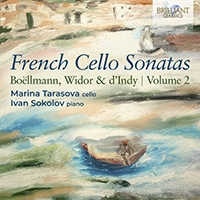
French Cello Sonatas Vol. 2: Boëllmann, Widor & d'Indy
12,00 €
Formát:
CD
Dostupnosť:
7-14 dní
Katalógové číslo:
96821
EAN kód:
5028421968216
Autori:
Charles-Marie Widor, Leon Boellmann, Vincent d Indy
Interpreti:
Ivan Sokolov, Marina Tarasova
Vydavateľ:
BRILLIANT CLASSICS
Zoznam skladieb
Dátum vydania: 7. 7. 2023Léon Boëllmann: Cello Sonata in A Minor, Op. 40
1 I. Maestoso
2 II. Andante
3 III. Allegro molto
Charles-Marie Widor: Cello Sonata in A Major, Op. 80
4 I. Allegro moderato
5 II. Andante con moto
6 III. Allegro vivace
Vincent D'Indy: Sonata for Cello and Piano in D Major, Op. 84
7 I. Entree
8 II. Gavotte en rondeau
9 III. Air
10 IV. Gigue
Popis
Leon Böellmann (1862-1897) was born in the Alsatian town of Ensisheim. He moved to Paris after the Franco-Prussian War after which Alsace became part of Germany. In Paris, he studied organ, piano and composition at the Classical Music School, graduating from it with honors. After graduation, he worked as a teacher at school. His compositions brought him considerable recognition, and he would almost certainly have made a bigger name for himself if he had not died at the young age of 35. Presented on this album is his remarkable Cello Sonata Op.40, hailing from the late French Romantic period. The Cello Sonata Op.80 in A major of 1907, by Charles-Marie Widor (1844–1937), is a grandiose work consisting of three movements with a magnificent introduction, foreshadowing a sonatafull of ideas. When comparing the cello part with other sonatas of the period, a cellist feels that Widor cared little for technical constraints. Due in part to the use of huge intervals, the cello part matches the piano part for virtuosity. The sonata’s premiere was given by Jules Lebeau and the composer on 14 March 1907 at the salon of Madame Max, who also offered Widor’s Violin Sonata Op.79 in the same program. Vincent d’Indy (1851–1931) was a French composer and organist, conductor and teacher, music critic, publicist and meaningful public figure. He lived a long and active live throughout at least three epochs of French history. He is considered the greatest representative of the César Frank School of composition. His Sonata for Cello and Piano Op.84 was written in 1925 when d’Indy was over 70 years old. His style had undergone significant changes in the years following his retirement and move from Paris to the southof France, where he composed a series of works generally in a bright and cheerful mood. Despite its name, this Sonata in fact takes the form of a Baroque suite. The opening movement (Entrée) is elegant and charming. This is followed by a Gavotte in Rondo, in which pizzicato in the cello is used to evoke the lute. The third part (titled "Air") is characterized by a soft and melancholic mood. The finale (Gigue) is a lively updated form of this baroque dance.