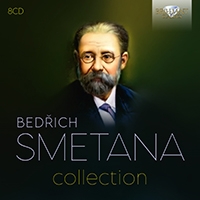
Bedřich Smetana Collection (8CD)
35,00 €
Formát:
CD BOX
Dostupnosť:
7-14 dní
Katalógové číslo:
96909
EAN kód:
5028421969091
Autori:
Bedřich Smetana
Interpreti:
Antonín Kubálek, Chor der Staatsoper Dresden, Janacek Philharmonic Orchestra, Joachim Trio, Otmar Suitner, Roberto Plano, Staatskapelle Dresden, Stamitz Quartet, Theodore Kuchar
Vydavateľ:
BRILLIANT CLASSICS
Zoznam skladieb
CD 1Má vlast, JB 1:112
1 I. Vyšehrad
2 II. Vltava (The Moldau)
3 III. Šarka
4 IV. From Bohemia’s Meadows and Forests
5 V. Tábor
6 VI. Blanik
CD 2
1 Wallenstein’s Camp, Symphonic Poem Op. 14
2 Hakon Jarl, Symphonic Poem Op. 16
3 Richard III, Symphonic Poem Op. 11
4 Overture to “The Bartered Bride”, JB 1:100
Three Dances from “The Bartered Bride”, JB 1:100
5 I. Polka
6 II. Furiant
7 III. Skocna (Dance of the Comedians)
8 Doktor Faust Overture to the Puppet-play by Matej Kopecký, JB 1:85
9 Venkovanka The Peasant Woman, Polka, JB 1:115
10 Nasim Devam To our Girls, Polka, JB 1:86
CD 3
Festive Symphony in E Major, Op. 6
1 I. Allegro vivace
2 II. Largo maestoso
3 III. Scherzo, allegro vivace
4 IV. Finale, allegro non troppo ma energico
5 Festive Overture in C Major
6 Festive Overture in D Major, Op. 4
7 Prague Carnival Introduction & Polonaise
8 March of the National Guard
9 Shakespeare Festival March, Op. 20
CD 4
String Quartet No. 1 in E Minor, JB1:105
1 I. Allegro vivo appassionato
2 II. Allegro moderato a la polka
3 III. Largo sostenuto
4 IV. Vivace
String Quartet No. 2 in D Minor, JB1:124
5 I. Allegro
6 II. Allegro moderato
7 III. Allegro non più moderato
8 IV. Finale. Presto
Piano Trio in G Minor, Op. 15
9 I. Moderato assai
10 II. Allegro, ma non agitato
11 III. Finale. Presto
CD 5
1 Andante in E-Flat Major, JB 1:62
2 Pensée fugitive
Album Leaves, Op. 2
3 I. Prelude. Allegro
4 II. Chanson. Moderato
5 III. Vivace
6 IV. Allegro commodo, sempre marcato
7 V. Moderato con anima
8 VI. Andante ma non troppo
3 Characteristic Pieces, Op. 3
9 I. To Robert Schumann
10 II. Wayfarer’s Song
11 III. It Boils and it Roars
4 Sketches, Op. 4
12 I. Prelude
13 II. Idyll
14 III. Memory
15 IV. Persistent Endeavour
4 Sketches, Op. 5
16 I. Scherzo – Polka
17 II. Melancholy
18 III. Friendly Landscape
19 IV. Rhapsody
Album Leaves
20 I. Allegretto ma non troppo in B-Flat Major
21 II. Allegro in B Minor
22 III. Toccatina
23 IV. Album Leaf in G Major- Trio
24 V. Lento in E-Flat Minor
25 VI. Con moto in B-Flat Minor
26 VII. For Katerina Kolarova – Moderato
27 VIII. For Elisabeth F. Thun – Allegro
28 IX. For Josephine Finke – Agitato
29 X. For Jean Kunz – Allegro
30 XI. For Václav Ulwer – Grave
31 XII. For Marie Proksch – Moderato
32 XIII. Andante in F Minor
33 XIV. Romance in G Minor
CD 6
The Complete Czech Dances I, JB 1:107
1 I. Polka in F-Sharp Minor
2 II. Polka in A Minor
3 III. Polka in F Major
4 IV. Polka in B-Flat Major
The Complete Czech Dances II, JB 1:11
5 I. Furiant
6 II. Slepicka (Little Hen)
7 III. Oves (Grain Dance)
8 IV. Medved (Bear Dance)
9 V. Cibulicka (Little Onion)
10 VI. Dupák (Stamping Dance)
11 VII. Hulán (Lancer)
12 VIII. Obkrocák (Stepping Dance)
13 IX. Sousedská (Neighbour’s Dance)
14 X. Skocná (Hop Dance)
CD 7
Die Verkaufte Braut, JB 1:100
1 I. Ouvertüre
Part 1
2 II. Seht am Strauch die Knospen springen
3 III. Sag, mein liebes Herz
4 IV. Zum Tanze rufen sie mich heut
5 V. Gern ja will ich dir vertrauen
6 VI. Sage, was dich von Hause fort
7 VII. Mit der Mutter sank zu Grabe
8 VIII. Nun in Lust und Leide
9 IX. Alles ist so gut wie richtig
10 X. Freilich! Den Tobias Micha
11 XI. Er wär’ gerne mit mir gekommen
12 XII. Seht, da kommt sie wie gerufen
13 XIII. Mit Hans bin ich vereint!
14 XIV. Durch die reihen hin zu fliegen
Part 2
15 I. Wie schäumst du in den Krügen
16 II. Furiant
17 III. Teurer Sohn, sprach Mütterlein
18 IV. Seid ihr nicht der Bräutigam
19 V. Eine gibt es hier im Dorf
CD 8
Die Verkaufte Braut, JB 1:100, Part 2:
1 VI. Komm, mein Söhnchen
2 VII. Wer in Lieb entbrannt
3 VIII. Gib die törichte Liebschaft auf
4 IX. Armer Narr
5 X. Es muß gelingen
6 XI. Nicht zu hitzig
Part 3
7 I. O was ich mich betrübe!
8 II. Marsch der Komödianten
9 III. Tanz und Produktion der Komödianten
10 IV. Ei, ei, wie reizend!
11 V. He, mein Teurer
12 VI. Alles geht am Schnürchen
13 VII. Ach, wie wird es mir ergehn
14 VIII. Ha, das trifft wie ein Donnerschlag
15 IX. Nein! Nein!
16 X. Hab ich verdient so tiefe Schmach
17 XI. He, Wenzel!
18 XII. Noch ein Weilchen, Marie
19 XIII. Endlich allein!
20 XIV. Der Liebestraum war wunderschön
21 XV. So find ich dich
22 XVI. Ha, ha, ha, ha!
23 XVII. Mein lieber Schatz, nun aufgepaßt!
24 XVIII. He, Hans! Möchtest du dein Geld
25 XIX. Gesegnet, wer liebt und auch vertraut
26 XX. Kommen wir gerne, so kommen wir gleich
27 XXI. Was seh ich
28 XXII. Wer hätte das von ihm gedacht
29 XXIII. Der Bär ist los!
30 XXIV. So ist’s recht, es freut uns alle
Popis
The most complete collection available of music by the father of Czech nationalism in music.
Má Vlast, The Bartered Bride and the String Quartet ‘From My Life’: all written within a decade of each other, all so fundamental in their different genres in forming a Czech national identity in music that it can seem incredible they were the work of a single composer. Yet this was the task that Bedřich Smetana (1824-1884) had set himself from early on – not only to become ‘a Liszt in technique and a Mozart in composition’ but the voice of a new nation. Given the obstacles he faced, his success in realising this ambition is all the more impressive. To begin with he had to overcome his father’s antipathy to his chosen destiny as a composer; then the vicissitudes of poverty, and then, at the height of his powers and renown, a succession of personal tragedies which left him deaf and mentally unstable; he died in reduced circumstances, living with his daughter, and it took the following generation of Czech composers to rehabilitate the hero who had lived in their midst. To begin with, Smetana won a reputation as the life and soul of the party thanks not least to the kind of piano miniatures which were published as his earliest surviving works. He sent one set to Liszt, who replied with characteristic generosity, and the elder composer’s example, encouragement and friendship all became crucial to Smetana as he spread his wings. Large-scale orchestral works soon followed in his late 20s, such as the powerful if rambling Festive Symphony – here performed complete, a rarity in itself – and the G minor Piano Trio, written as an outpouring of grief at the death of his daughter Bedřiška, and a powerful foreshadowing of later masterpieces. Finding recognition in his homeland hard to come by, he moved to Sweden, and it was only on his permanent return home in the early 1860s that The Bartered Bride and then Má Vlast took shape, each through a complex genesis outlined by a new booklet essay and appreciation of the composer by Peter Quantrill. In their final forms they were acclaimed as the work of someone worthy to be hailed as a ‘Czech Beethoven’, for their heroic style, their mastery of old forms with a distinctively Czech twist, and their celebration of the nation’s history and sense of itself.