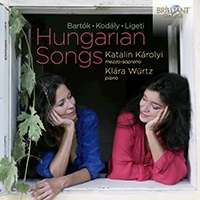
Hungarian Songs: Bartók / Kodály / Ligeti
12,00 €
Formát:
CD
Dostupnosť:
backorder/ dodacia doba 7-14 dní
Katalógové číslo:
96926
EAN kód:
5028421969268
Autori:
Béla Bartók, György Ligeti, Zoltán Kodály
Interpreti:
Katalin Károlyi, Klára Würtz
Vydavateľ:
BRILLIANT CLASSICS
Zoznam skladieb
Dátum vydania: 7. 7. 2023György Ligeti: Három weöres-dal, 3 Songs on Poems by Sándor Weöres
1 I. Táncol a hold
2 II. Gyümölcs-fürt
3 III. Kalmár jött nagy madarakkal
György Ligeti: Öt Arany-dal, 5 Songs on Poems by János Arany
4 I. Csalfa sugar
5 II. A legszebb virág
6 III. A csendes dalokból
7 IV. A bujdosó
8 V. Az ördög elvitte a fináncot
9 Zoltán Kodály: Magos kősziklának (Magyar népzene K.49, V. No. 1)
10 Zoltán Kodály: Ifjúság, mint sólyommadár (Magyar népzene K.49, V. No. 3)
11 Zoltán Kodály: Az hol én elmegyek (Magyar népzene K.49, I. No. 2)
12 Zoltán Kodály: Csillagom, révészem (Magyar népzene K.49, V. No. 5)
13 Zoltán Kodály: Magos a rutafa (Magyar népdalok K.22, No. 12)
Béla Bartók: Nyolc magyar népdal BB 47, 8 Hungarian Folk Songs
14 I. Fekete főd
15 II. Istenem, istenem
16 III. Asszonyok, asszonyok
17 IV. Annyi bánat az szűvemen
18 V. Ha kimegyek
19 VI. Töltik a nagy erdő útját
20 VII. Eddig való dolgom
21 VIII. Olvad a hó
Béla Bartók: Öt magyar népdal BB 97, 5 Hungarian Folk Songs
22 I. Elindultam szép hazámból
23 II. Által mennék én a tiszán ladikon
24 III. A gyulai kert alatt
25 IV. Nem messze van ide kis Margitta
26 V. Végigmentem a tárkányi
Béla Bartók: Tíz magyar dal BB 43, 10 Hungarian Songs
27 I. Tiszán innen, Tiszán túl
28 II. Erdők, völgyek, szűk ligetek
29 VIII. Sej, mikor engem katonának visznek
30 X. Kis kece lányom
Béla Bartók: Falun BB 87, Village Scenes:
31 I. Szénagyűjtéskor
32 II. A menyasszonynál
33 III. Lakodalom
34 IV. Bölcsődal
35 V. Legénytánc
Popis
Only one year and a half after their first meeting in Budapest in early 1905, Bartók and Kodály were eager to jointly publish their first settings of Hungarian folk songs. In their foreword to the volume Magyar népdalok (Hungarian Folk Songs), they declare their goal thus: “…to get the general public to know and appreciate folk songs.” The Ten Hungarian Folk Songs from 1906 (BB 43), Bartók’s earliest and still quite rudimentary but imaginative and very sensitive folk-song arrangements, were collected by the 25-year-old himself mostly in three regions of the Hungarian countryside: near Budapest, Békéscsaba, and the lake Balaton. This set, from which we can listen to four arrangements on this cd, has never been offered by Bartók to be published. Having collected peasant music from regions of the Hungarian Kingdom where significant Romanian and Slovak minorities lived, Bartók immediately became intrigued by the peculiarities – and from his point of view, musical freshness – of both nations’ songs and instrumental dances. His reverence for the folklore of the Slovaks can be felt in the five arrangements of the Falún (Village Scenes) series (BB 87a), composed in 1924 and based on folk songs from the Zólyom (in Slovakian: Zvolenská) region of what was then Upper Hungary (now Slovakia) he collected in 1917 from village women. These arrangements of bursting energy, enchantingly deep emotionality and transcendence also bear testimony to Bartók’s discovery of Stravinsky’s music which he was galvanised by in the early 1920s. The texts are sung by Katalin Károlyi in Hungarian here, not in their original Slovak-language version. Before leaving Hungary for Austria and West Germany after the fall of the 1956 revolution, György Ligeti (1923–2006) not only collected folk music in his native Transylvania but also worked for the Institute for Folklore in Bucharest and Kolozsvár in the late 1940s. Thus, in his twenties and thirties, he followed the footsteps of his idols, Bartók and Kodály. In the last months of 1952, Ligeti set to music five poems by János Arany, a leading figure of 19th-century Hungarian poetry. Both text and music are deeply rooted in Hungarian folk songs; indeed, most of Ligeti’s melodies, or parts thereof, could be actual folk songs, just like Arany’s texts from almost a century earlier could be folk-song texts. The last piece is an exception, being a daring musical setting of Arany’s 1868 Hungarian translation of Robert Burns’ humorous song The Deil’s Awa Wi’ Th’ Exciseman (1792).