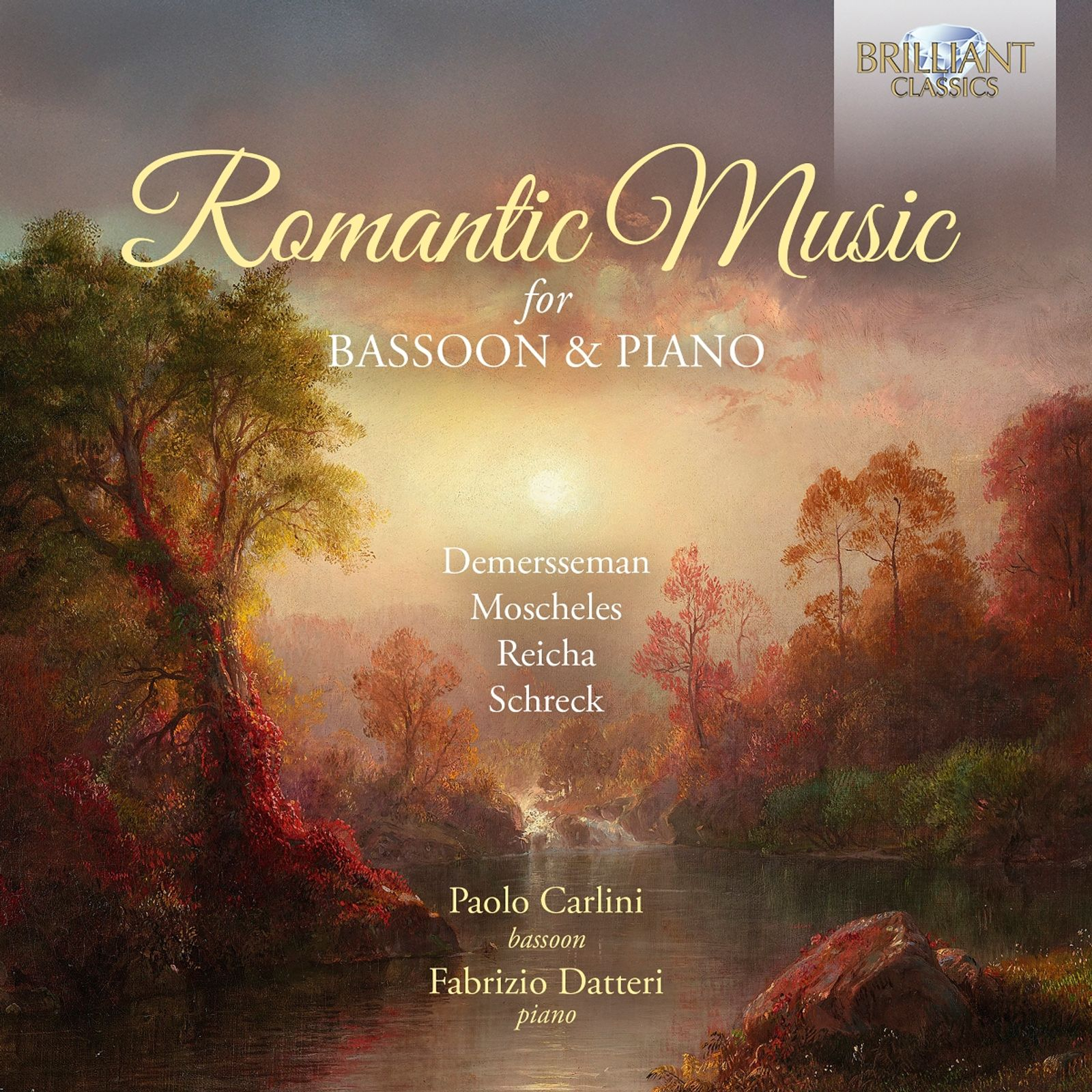
Romantic Music for Bassoon and Piano
15,00 €
Formát:
CD
Dostupnosť:
na sklade / in stock
Katalógové číslo:
97503
EAN kód:
5028421975030
Autori:
Antonín Rejcha, Gustav Schreck, Ignaz Moscheles, Jules Demersseman
Interpreti:
Fabrizio Datteri, Paolo Carlini
Vydavateľ:
BRILLIANT CLASSICS
Zoznam skladieb
Dátum vydania: 11. 4. 20251 Jules Demersseman: Introduction et polonaise, Op. 30
Gustav Schreck: Sonata Op. 9 for Bassoon and Piano
2 I. Allegro ma non troppo
3 II. Largo
4 III. Allegro-Più mosso
Anton Reicha: Sonata for Bassoon and Piano
5 I. Allegro
6 II. Adagio
7 III. Rondò-Allegretto
Ignaz Moscheles: Grande sonate concertante in B-Flat Major, Op. 34
8 I. Allegro moderato
9 II. Andante doloroso
10 III. Allegro molto
Popis
Jules Demersseman (1833–1866) was a great flautist; at the age of 11 he won a prize in Paris and was hailed a virtuoso. As a composer, in addition to writing works for his own instrument, he became one of the first in France to write for the newly developed saxophone. In his Introduction et Polonaise, a pleasant piece with an essentially 18th-century feel, there are hints of flute phrasing. The opening Allegretto is immediately followed by a Largo with a recitative character, while in the Polonaise the piano, after the opening bars, gives way to the featured bassoon. It is the wind instrument that leads the dance and does so with grace and pleasantness.
Ignaz (Isaac) Moscheles (1794–1870) belongs to that series of pianist–composers who emphasized ‘physiological’ characteristics of the instrument, transmitting paroxysmal force into it and revolutionising its technique beyond what was inherited from the harpsichord. He sets his Grande Sonate concertante Op.34 on the piano in a very virtuosic manner, alternating between bassoon–piano dialogue and a predominance of the latter. The opening Allegro moderato is marked, with passionate moments; an Andante doloroso follows, ending with a piano cadenza. Even in the extended concluding Allegro molto, the piano has a very demanding part that enhances a heated expressiveness.
Antonín Reicha (1770–1836) was a contemporary of Beethoven, and prominent in his catalogue are compositions for wind instruments, with their imaginative and innovative exploitation of their technical and timbral possibilities, effectively surpassing the classical sonata in favour of formal and expressive cues that were a source of inspiration for Romantic sentiment. His Sonata for bassoon and piano clearly recalls – in its formal organization of the musical material – Beethoven’s Sonatas for instrumental duo. It is on the level of poetics, however, that Reicha goes further, creating moments of great melodic expressiveness.
Gustav Ernst Schreck (1848–1918) was a composer especially of oratorios and of chamber music, where his Bassoon Sonata Op.9 is a stand-out work. His writing was nourished by the Germanic Romantic tradition, with clear homages to Schumann’s Phantasiestücke and a typically Romantic dialectical relationship between two instruments. The initial Allegro ma non troppo is brisk, and the instruments are well interwoven with each other; in the Largo the dynamic variations are important, giving variety and expressive subtleties; this is followed by an Allegro where the instruments are always very legato, organized in a very compact warp that never loses sight of expressiveness.