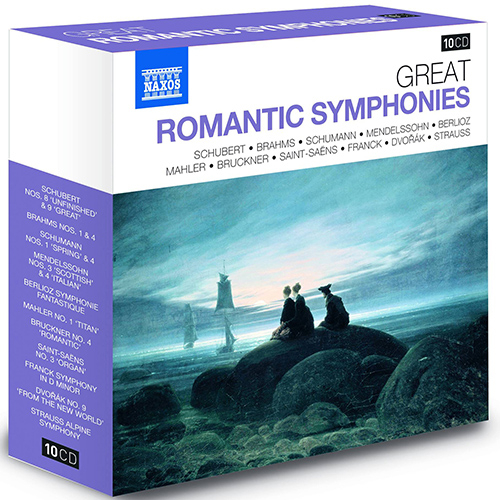
Great Romantic Symphonies (10CD)
40,00 €
Formát:
CD BOX
Dostupnosť:
na sklade / in stock
Katalógové číslo:
8.501057
EAN kód:
730099105743
Autori:
Anton Bruckner, Antonín Dvořák, Camille Saint-Saens, César Franck, Felix Mendelssohn-Bartholdy, Franz Schubert, Gustav Mahler, Hector Berlioz, Johannes Brahms, Richard Strauss, Robert Schumann
Interpreti:
Alexander Rahbari, Antoni Wit, Arnhem Philharmonic Orchestra, Belgian Radio and Television Philharmonic Orchestr, Budapest Failoni Chamber Orchestra, Georg Tintner, Ireland National Symphony Orchestra, Michael Halasz, Polish National Radio Symphony Orchestra, Reinhard Seifried, Roberto Benzi, Royal Scottish National Orchestra, San Diego Symphony Orchestra, Slovak Philharmonic Orchestra, Slovak Radio Symphony Orchestra, Stephen Gunzenhauser, Weimar Staatskapelle, Yoav Talmi, Zdeněk Košler
Vydavateľ:
NAXOS
Zoznam skladieb
CD 1Franz Schubert
Symphony No. 8 in B Minor, D. 759, "Unfinished"
1 I. Allegro moderato
2 II. Andante con moto
Symphony No. 9 in C Major, D. 944, "Great"
3 I. Andante - Allegro ma non troppo
4 II. Andante con moto
5 III. Scherzo: Allegro vivace
6 IV. Finale: Allegro vivace
CD 2
Johannes Brahms: Symphony No. 1 in C Minor, Op. 68
1 I. Un poco sostenuto - Allegro
2 II. Andante sostenuto
3 III. Un poco allegretto e grazioso
4 IV. Adagio - Allegro non troppo ma con brio
Robert Schumann: Symphony No. 1 in B-Flat Major, Op. 38, "Spring"
5 I. Andante un poco maestro - Allegro molto vivace
6 II. Larghetto
7 III. Scherzo: Molto vivace
8 IV. Allegro animato e grazioso
CD 3
Johannes Brahms: Symphony No. 4 in E Minor, Op. 98
1 I. Allegro non troppo
2 II. Andante Moderato
3 III. Allegro Giocoso - Poco meno Presto
4 IV. Allegro Energico e Passionato - Più Allegro
Robert Schumann: Symphony No. 4 in D Minor, Op. 120
5 I. Ziemlich langsam - Lebhaft
6 II. Romanze: Ziemlich langsam
7 III. Scherzo: Lebhaft
8 IV. Langsam - Lebhaft
CD 4
Felix Mendelssohn-Bartholdy
Symphony No. 3 in A Minor, Op. 56, MWV N19, "Scottish"
1 I. Andante con moto - Allegro un poco agitato - Andante come prima
2 II. Vivace non troppo
3 III. Adagio
4 IV. Allegro vivacissimo - Allegro maestoso assai
Symphony No. 4 in A Major, Op. 90, MWV N16, "Italian"
5 I. Allegro vivace
6 II. Andante con moto
7 III. Con moto moderato
8 IV. Saltarello: Presto
CD 5
Hector Berlioz
Symphonie fantastique, Op. 14
1 I. Reveries: Largo - Passions: Allegro agitato e appassionato assai
2 II. Un Bal (Valse): Allegro non troppo
3 III. Scene aux Champs: Adagio
4 IV. Marche au Supplice: Allegretto non troppo
5 V. Songe d'une Nuit du Sabbat: Larghetto - Allegro
6 Benvenuto Cellini, Op. 23
7 Le carnaval romain, Op. 9
CD 6
Gustav Mahler
Symphony No. 1 in D Major, "Titan"
1 I. Langsam, schleppend
2 II. Kräftig bewegt, doch nicht zu schnell
3 III. Feierlich und gemessen, ohne zu schleppen
4 IV. Sturmisch bewegt
5 Blumine (original second movement)
CD 7
Anton Bruckner: Symphony No. 4 in E-Flat Major, WAB 104, "Romantic" (1881 version, ed. R. Haas)
1 I. Bewegt, nicht zu schnell
2 II. Andante quasi allegretto
3 III. Scherzo: Bewegt
4 IV. Finale: Bewegt, doch nicht zu schnell
CD 8
Camille Saint-Saëns: Symphony No. 3 in C Minor, Op. 78, "Organ"
1 I. Adagio - Allegro moderato -
2 I. Poco adagio
3 II. Allegro moderato - Presto - Allegro moderato - Presto - Allegro moderato -
4 II. Maestoso - Allegro - Più allegro - Molto allegro - Pesante
César Franck: Symphony in D Minor
5 I. Lento: Allegro non troppo
6 II. Allegretto
7 III. Finale: Allegro non troppo
CD 9
Dvořák, Antonín
Symphony No. 9 in E Minor, Op. 95, B. 178, "From the New World"
1 I. Adagio
2 II. Largo
3 III. Molto vivace
4 IV. Allegro con fuoco
5 Symphonic Variations, Op. 78, B. 70
CD 10
Richard Strauss: Eine Alpensinfonie (An Alpine Symphony), Op. 64, TrV 233
1 Nacht (Night) -
2 Sonnenaufgang (Sunrise) -
3 Der Anstieg (The Ascent) -
4 Eintritt in den Wald (Entry into the Wood) -
5 Wanderung neben dem Bache (Wandering by the Stream) -
6 Am Wasserfall (At the Waterfall) -
7 Erscheinung (Apparition) -
8 Auf blumigen Wiesen (On Flowering Meadows) -
9 Auf der Alm (On the Alpine Pasture) -
10 Durch Dickicht und Gestrupp auf Irrwegen (Straying through Thicket and Undergrowth) -
11 Auf dem Gletscher (On the Glacier) -
12 Gefahrvolle Augenblicke (Dangerous Moments) -
13 Auf dem Gipfel (On the Summit) -
14 Vision -
15 Nebel steigen auf (Mists rise) -
16 Die Sonne verdustert sich allmählich (The Sun gradually darkens) -
17 Élégie -
18 Stille vor der Sturm (Calm before the Storm) -
19 Gewitter und Sturm, Abstieg (Thunder and Storm, Descent) -
20 Sonnenuntergang (Sunset) -
21 Ausklang (Final Sounds) -
22 Nacht (Night)
23 Don Juan, Op. 20, TrV 156
Popis
The word ‘symphony’ is used to describe an extended orchestral composition in Western classical music. By the eighteenth century the Italianate opera sinfonia—musical interludes between operas or concertos—had assumed the structure of three contrasting movements, and it is this form that is often considered as the direct forerunner of the orchestral symphony. With the rise of established professional orchestras, the symphony assumed a more prominent place in concert life between 1790 and 1820 until it eventually came to be regarded by many as the yardstick by which one would measure a composer’s achievement. The nineteenth century brought various changes to the symphonic form. Although both inspired by Beethoven, Berlioz’s experiments with instrumental colour and orchestral size are a world away from the colossal symphonies of Brahms. Composers such as Mahler and Bruckner pushed the traditional symphonic landscapes to their limits, in sharp contrast to the uplifting Classically based symphonies of Mendelssohn and Schubert. The nationalistic flavours apparent in the programme symphonies of Schumann, Strauss and Dvořák exemplify the way in which the symphonic form flourished in the Romantic era, whilst the visceral impact of the Gallic panache is typified by the symphonies of Franck and Saint-Saëns.