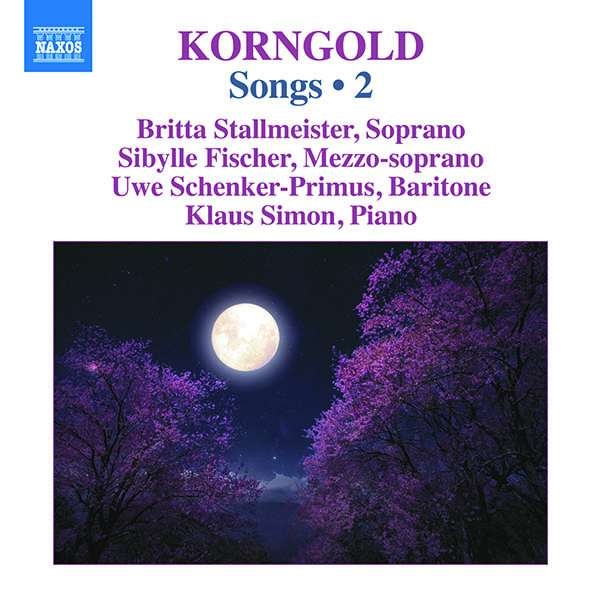
Korngold: Songs, Vol. 2
10,00 €
Formát:
CD
Dostupnosť:
backorder / dodacia doba 10-28 dní
Katalógové číslo:
8.573083
EAN kód:
747313308378
Autori:
Erich Wolfgang Korngold
Interpreti:
Britta Stallmeister, Klaus Simon, Peter Franck, Philip Roy, Sibylle Fischer, Uwe Schenker-Primus
Vydavateľ:
NAXOS
Zoznam skladieb
4 Abschiedslieder (4 Songs of Farewell), Op. 14 (version for voice and piano)1. No. 1. Sterbelied (When I am dead, my dearest)
2. No. 2. Dies eine kann mein Sehnen nimmer fassen (This one thing my longing can never grasp)
3. No. 3. Mond, so gehst du wieder auf (So, moon, are you again rising)
4. No. 4. Gefaßter Abschied (A Composed Farewell)
3 Lieder, Op. 18
5. No. 1. In meine innige Nacht (I am entering my innermost night)
6. No. 2. Tu ab den Schmerz (Lay aside your pain)
7. No. 3. Versuchung (Temptation)
8. The Constant Nymph: Morgen (Tomorrow), Op. 33 (reconstructed by K. Simon for voice and piano trio, sung in German)
9. 5 Lieder, Op. 38: No. 1. I Wish You Bliss (Glückwunsch) (Sung in English)
10. 5 Lieder, Op. 38: No. 2. Wings (Der Kranke) (Sung in English)
11. 5 Lieder, Op. 38: No. 3. Old Spanish Song (Alt-Spanisch)
12. 5 Lieder, Op. 38: No. 4. Old English Song (Alt-Englisch)
13. 5 Lieder, Op. 38: No. 5. My Mistress' Eyes (Kein Sonnenglanz)
14. Sonett für Wien (Sonnet for Vienna), Op. 41
15. Nachts (During the Night)
16. Der innere Scharm (Inward Charm)
17. Österreichischer Soldatenabschied (An Austrian Soldier's Farewell)
18. Ausser (Unless)
19. Etwas ganz Persönliches (Something Very Personal) (arr. H. Fuhlbom and K. Simon for voice and piano trio)
20. Die Gansleber im Hause Duschnitz (Goose Liver at the Duschnitz's House)
21. Quinquaginta-Foxtrott (Quinquaginta Foxtrot)
Popis
In his song settings, Korngold pursued the Romantic ideal and lavished considerable care and inventiveness on their composition. His seemingly effortless gift for melody is everywhere apparent in this second volume (Vol. 1 is on 8.572027), whether in the early works or the songs from the 1940s, which would not sound out of place in an operetta or a Broadway musical. Also present, notably in the Drei Gesänge, Op. 18, is an exciting, experimental approach to harmony that reflects the music of his most radical opera, Das Wunder der Heliane (8.660410–12).