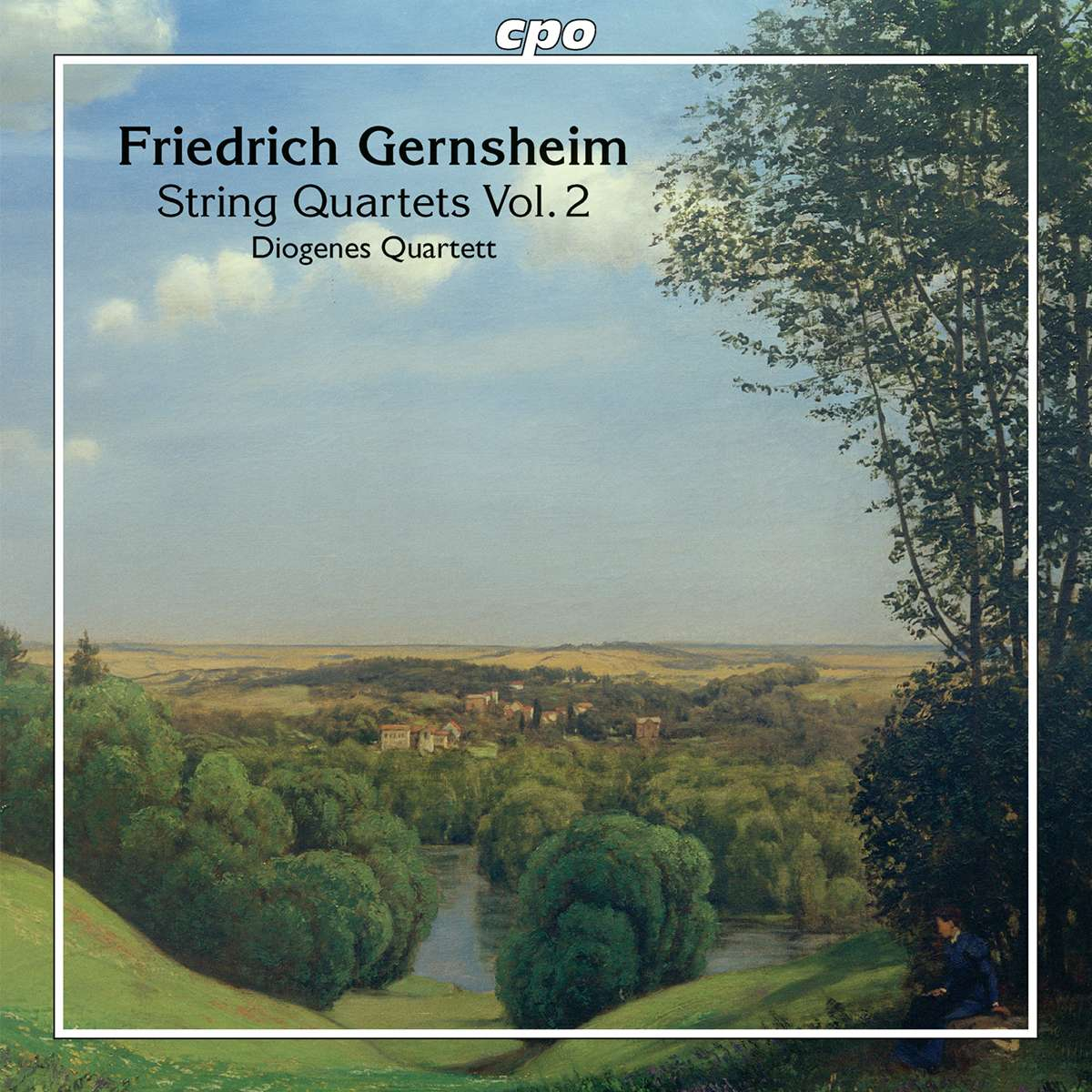
Gernsheim: String Quartets Vol. 2
9,00 €
Formát:
CD
Dostupnosť:
na sklade / dostupné okamžite
Katalógové číslo:
555 468-2
EAN kód:
761203546824
Autori:
Friedrich Gernsheim
Interpreti:
Alba González i Becerra, Alexander Hülshoff, Diogenes Quartett, Gundula Kirpal, Stefan Kirpal, Stephen Ristau
Vydavateľ:
CPO
Zoznam skladieb
String Quartet No. 5 op. 83 in A major1 1. Allegro non troppo
2 2. Molto vivace - Risoluto - Tempo I - Risoluto e un poco pesante - Tempo I - Risoluto - Tempo I - Vivacissimo
3 3. Andante sostenuto e molto cantabile
4 4. Allegro vivace e con brio
String Quartet op. 89 in E flat major
5 1. Allegro moderato e molto cantabile
6 2. Allegro vivace con brio - Andante patetico - Tempo I
7 3. Adagio
8 4. Allegro - Molto vivace e con brio
Popis
It is above all the string quartet genre in which Gernsheim has earned great merit with his new ideas. The Diogenes Quartet interpreted the first and third quartets on Vol. 1 of our complete recording. FonoForum attested that the Diogenes Quartet "plays this music in an almost ideal way. In this interpretation, the music is given a warmth of feeling that never slips into kitschy sentimentality. In terms of interpretation, this is a tightrope walk that the quartet manages as a matter of course: unobtrusively sophisticated." (FonoForum 9 / 2019) On Vol. 2, the quartet dedicates itself to the String Quartet op. 83 and the String Quintet op. 89. His Quartet op. 83 was first published in 1911 by N. Simrock, but unlike Gernsheim's other chamber music works, it was only published in parts without a score. It was premiered by the Klingler Quartet. Karl Klingler was concertmaster of the Berlin Philharmonic Orchestra, at times a member of the Joachim Quartet and later its successor at the Berlin Academy of Music, and is also the dedicatee of the work. The movements show Gernsheim's melodic qualities on the one hand and at the same time the disjointedness of his late style. Gernsheim does not usually dwell on one melodic idea for long; the movement is characterized by short sections from which small motifs continue to develop. The whole thing is accompanied by harmonic backward shifts, an exuberant chromaticism and playing with major-minor shades. Gernsheim always remains rooted in the tonal tradition, but has already moved a long way away from the style of his late friend Brahms. Although his Quintet op. 89 was premiered in March 1916 while the composer was still alive, it was never printed. Everything is very chromatic up to the limits of diatonicism, but not beyond, and is somewhat reminiscent of Max Reger's chamber music. Gernsheim takes the intricacy, the chromatic, dynamic and motivic contrasts and the outbursts to an even greater extreme than in his last string quartet. The movement displays such a great variety of ideas, as if Gernsheim had sensed that it was to be his last chamber music work and therefore wanted to pack everything into it once again.