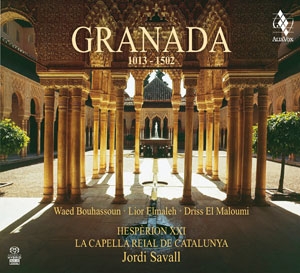
Granada 1013-1526 (SACD)
18,00 €
Formát:
SACD
Dostupnosť:
7-14 dní
Katalógové číslo:
AVSA9915
EAN kód:
8435408099158
Autori:
Anonym., traditional
Interpreti:
Hespèrion XXI, Jordi Savall, La Capella Reial de Catalunya
Vydavateľ:
ALIA VOX
Zoznam skladieb
1. Invocación Qamti be-Ishon Layla (Cantar de los Cantares. Inspirado en Cantar 3, 1-4)2. Taqsim instrumental & Danza morisca (Ney)
3. Moaxaja: Billadi askara min aadbi Llama - Al-Andalus
4. Preces: Penitentes orate - Plegaria mozárabe s. XI
5. Ductia (instr.) - Cantiga de Santa María (CSM 123) - Alfonso X El Sabio
6. Siónida: Yefe Nof - Yehudá Haleví (1075-1141)
7. Taqsim (Kanun) - Improvisación - Moaxaja: Ya gosan naqa - Ibn Zuhr - Tradición Al-Ándalus
8. Fragmento de la Carta sobre la conversión forzosa Iggeret ha-Shemad, cap. IV - Las Estrellas de los cielos
9. Danza morisca
10. Lamento: Plange Castella misera - Anónimo, Códice de Las Huelgas, f. 160, s. X
11. Danza de iniciación (instrumental)
12. Lamento hebraico-andaluz Dror yiqrá - Dunash ben Labrat, s. X
13. Poema en piedra de la Alhambra de Granada. Texto en árabe de Ibn Zamrak - Taqsim
14. Pero que seja a gente - Cantiga de Santa María (CSM 181) - Alfonso X El Sabio
15. Romance fronterizo: Cerco de Baeza - Anónimo, Cancionero de Palacio (CMP 106)
16. Lamento: El camino – La angustia - Improvisación andalusí
17. Propiñan del Melyor (instr.) - Anónimo, s. XV
18. Villancico: Aquella mora garrida - Gabriel, Cancionero de Palacio (CMP 254)
19. Villancico: Viva el gran Re Don Fernando - Carlo Verardi
20. Romance: El pan de la aflicción - Plegaria sefardí
21. Diario de abordo de Cristóbal Colón, Noche del 11 al 12 octubre 1492
22. Villancico: Todos los bienes del mundo - Juan del Enzina
23. Crónica de los Reyes de Castilla, cap. CXCVI
24. Lamento andalusí Maqam hijaz - Ibn Zaydún (Córdoba 1003-Sevilla 1071)
Popis
Jordi Savall examines 500 years of history in this portrait of a city that symbolises like no other the fruitful, and at the same time, conflictual encounter of the three monotheistic religions. The succession of the Zirid, Almoravid, Almohad and Nasrid dynasties, their relationship with the neighbouring Christian kingdoms and the often precarious situation of the Jews (the first inhabitants of this area) are reflected in this wide musical fresco, in which each culture displays its most advanced refinement.