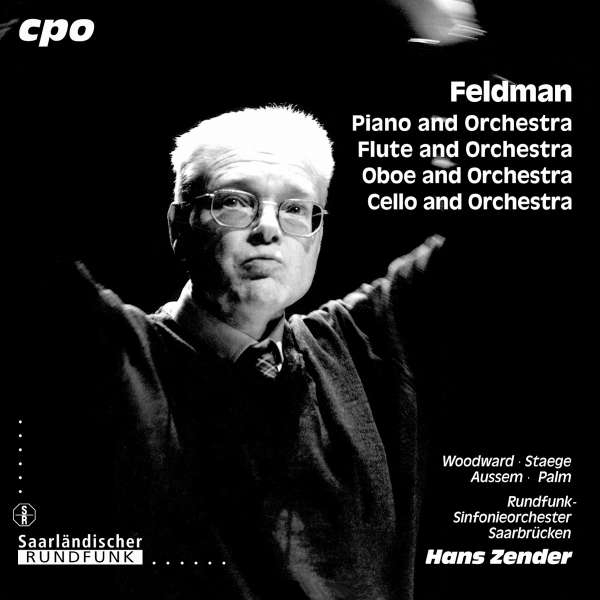
Feldman: Orchestra (2CD)
9,00 €
Formát:
CD
Dostupnosť:
7-14 dní
Katalógové číslo:
7830093
EAN kód:
761203948321
Autori:
Morton Feldman
Interpreti:
Hans Zender, Rundfunk-Sinfonieorchester Saarbrücken
Vydavateľ:
CPO
Zoznam skladieb
Disk 1 von 21
Konzert für Flöte und Orchester (1978)
2
Konzert für Violoncello und Orchester (1972)
Disk 2 von 2
1
Konzert für Oboe und Orchester (1976)
2
Konzert für Klavier und Orchester (1975)
Popis
The collaboration with John Cage at the beginning of the 1950s and the friendship with like-minded composers such as Earle Brown and painters such as Philip Gustin and Franz Kline were of great importance for the compositional career of the American composer Morton Feldman. Feldman developed his own tonal language in which the individual sound and its immediate effect were given a completely new role
"For me sound is the most important thing. I feel that I am subordinate to it. I feel that I listen to my sounds and do what they tell me but not what I have to say to them. Because these are the sounds I owe my life to, they give me existence."
Feldman explained his aesthetic approach in numerous lectures and essays, mainly written during his teaching activities at the University of New York in Buffalo
"What I have taken over from painting belongs to the basic knowledge of every art student. It's called the image plane. I have developed the hearing level for my ears accordingly and although this is a kind of balance, it has nothing to do with foreground / background. It has to do with how I keep it on the plane, don't let it fall out, don't let the sound fall to the floor."
Elsewhere, Feldman wrote that he had composed "by blurring the boundaries between material and construction, and merging method and application, concentrating on
dealing with
these categories in such a way
that the result was something that can only be classified with difficulty" While Feldman was until the middle of the fifties numerous
In later works he developed an increasingly differentiated form of notation, which gave him the opportunity to determine the finest tonal gradations.
Especially in
the seventies he composed several large compositions,
including a number of pieces for solo instrument(s) and orchestra
The
first work in this series is Cello and Orchestra,
which was completed in
mid-January 1972 during a
stay in Berlin. Feldman himself remarked
"There
must be something in the Berlin air that produced three extensive works in a few months in the winter of 1971 - 1972
. Cello and Orchestra was one of them."
The exact duration of the piece is set in the score at 18 minutes and 26 seconds, the tempo, as in most of Feldman's compositions, is relatively slow (quarter = 56-63). Likewise, the dynamics remain throughout in the piano or pianissimo range, with the exception of an unexpected fort in bar 136. The melodic material, if one can speak of Feldman as such at all, lies above all in the solo part, which
is notated for
long
stretches in treble clef
Feldman
composed
Piano and Orchestra
for the Australian pianist Roger Woodward
in 1975 "
The work continues the series of large forms that all have this still life title, which refers exclusively to the instruments used: chorus and orchestra (cello) and orchestra, string quartet and orchestra, all written since 1972,
in order to draw the
listener's attention more to the colour of the work than to the compositional
procedure (M. Feldman)
Also in "Piano and orchestra" here the tempo is slow throughout (quarter: 63-66), the instruments used extremely sparingly. Feldman explores the different timbres in the interaction of the piano with the individual orchestral instruments in a variety of ways. Often it is only single tones or static sounds whose color
changes
slowly, almost
imperceptibly
Oboe and Orchestra was composed as a commission of the Holland Festival and premiered in Rotterdam. The performers were Hans de Vries and the Radio Filharmonisch Orkest Hilversum under the direction of Jean Fournet. Despite the large orchestra with four woodwinds, 3 horns each, trumpets and trombones, a tuba as well as percussion (harp, piano), celesta and strings, the piece remains almost completely in the lower dynamic range. Only a few bars before the end does the whole orchestra rise to fortissimo.
"
Oboe and Orchestra" ends with a cluster of six tones of timpani that appear here for the first and only time within the piece
Flute and Orchestra was commissioned by the Saarländischer Rundfunk in 1977 / 78 and premiered in Saarbrücken on 19 May 1928 as part of the festival "Musik im 20. Jahrhundert". Roswitha Staege and the Rundfunk-Sinfonieorchester Saarbrücken under the direction of Hans Zender played. Feldman dedicated the piece to the composer Edgar Varese, who died in New York in 1965, with whom he
combined
the emphasis on the concrete instrumental sound, independent of melodic progressions, and the search for new and unusual timbres
"The work continues a recent thought that consists of not simply constructing a composition, but rather trying out what happens when you relate closely related material to such material that is not directly related to it. During the composing process, an additional principle arose that can be described as the wrapping and uncovering of the material in polyrhythmic structures. All this has nothing to do with collage. For me there is no such thing as foreground and background, but only primary material. The interval language is dense: fluctuating cells of three tones (two semitones and one whole tone step) in different permutations." (M. Feldman)