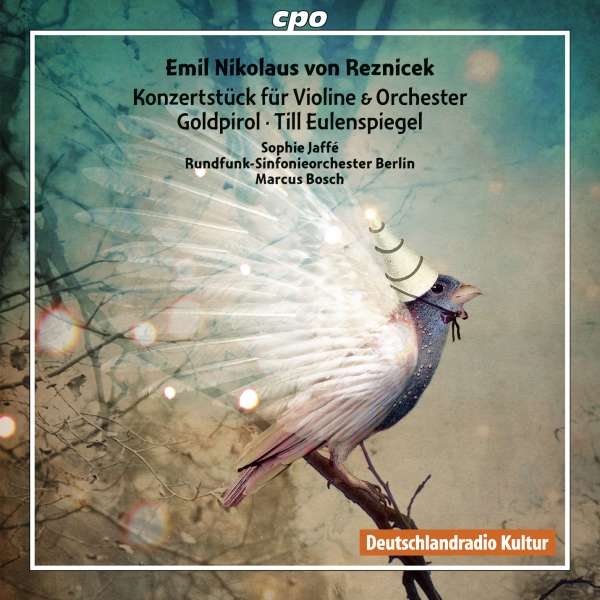
Reznicek: Konzertstück E-Dur für Violine & Orchester
10,00 €
Formát:
CD
Dostupnosť:
na sklade / dostupné okamžite
Katalógové číslo:
3097582
EAN kód:
761203798322
Autori:
Emil Nikolaus von Reznicek
Interpreti:
Marcus Bosch, Rundfunk-Sinfonieorchester Berlin, Sophia Jaffe
Vydavateľ:
CPO
Zoznam skladieb
1Goldpirol (Idyllische Ouvertüre)
2
Wie Till Eulenspiegel lebte (Sinfonisches Zwischenspiel in Form einer Ouvertüre)
Konzertstück für Violine und Orchester E-Dur
3
1. Allegro moderato
4
2. Tranquillo - Andante espressivo - Adagio - Con espressivo - Largo
5
3. Allegro ma non troppo (Schottischer Originaltanz)
Präludium und Fuge c-moll
6
Präludium
7
Fuge
8
Nachtstück für Violne, Hörner, Harfe und Streichorchester
Popis
The musical chameleon Emil Nikolaus von Reznicek is perhaps the composer of German late romanticism who had the most multifaceted style and is the most difficult to classify. Prior to the inauguration of cpo’s grand edition of Reznicek’s major works a few years ago, he was known to classical music fans solely as the composer of the Donna Diana Overture. In the meantime things have changed: on our many Reznicek releases listeners can experience for themselves all the stunts – seriously intended ones, mind you – performed by this master of metamorphosis. And things are no different on our latest CD release. Take, for example, the Goldpirol Overture: »In its bright and carefree mood, the piece reflects the vacation atmosphere by Tegernsee’s lake; in a broader sense, it also has to be regarded as a ‘satyr play’ going along with the preceding Tragic Symphony. The Goldpirol (Gold Oriole) motif quite naturally suggests the picture of a bird flying through the woods in the Alpine foothills. However, one might also think of Reznicek himself, who as an avid Nimrod frequently and fondly spent time exploring the world of nature. One would also tend to think that he was the one more capable of the stop at the Tegernsee Brewery, which had a wind band that is quite unmistakably heard in the middle part and shows the word ‘idyllic’ in an ironic light. In this respect one might also regard the work as an ironic commentary on the depictions of nature in Mahler’s symphonies« (Michael Wittmann).