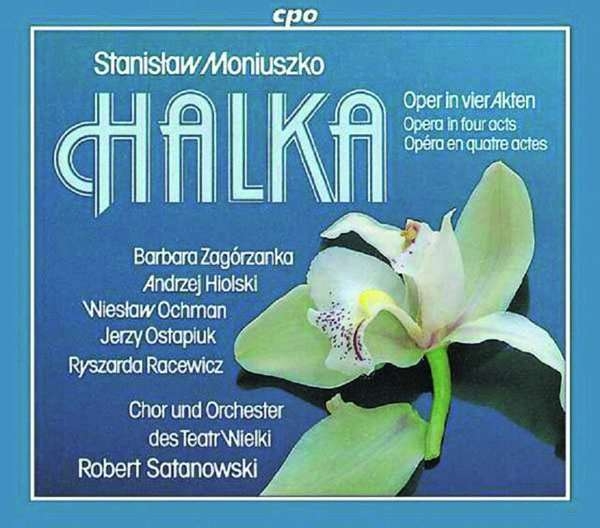
Moniuszko: Halka (Oper in 4 Akten) (2CD)
14,00 €
Formát:
CD
Dostupnosť:
na sklade / dostupné okamžite
Katalógové číslo:
5362385
EAN kód:
761203903221
Autori:
Stanislaw Moniuszko
Vydavateľ:
CPO
Zoznam skladieb
Disk 1 von 2Halka (Oper in 4 Akten) (Gesamtaufnahme)
1
Ouvertüre
2
Polonaise (1. Akt)
3
Terzett
4
Rezitativ und Lied des Janusz
5
Lied der Halka und Duett
6
Chor und Arie des Stolnik
7
Mazurka
8
Vorspiel (2. Akt)
9
Rezitativ und Arie der Halka
10
Halka - Jontek
11
Finale - Duett - Finale
Disk 2 von 2
1
Vorspiel (3. Akt)
2
Chor
3
Goralentänze
4
Chor
5
Finale
6
Vorspiel (4. Akt)
7
Sextett mit Chor
8
Duett Halka und Jantek
9
Gebet
10
Rezitativ und Kavatine
11
Finale
Popis
In the summer of 1846, the 27-year-old organist Stanislaw Moniuszko from Vilnius came to Warsaw to prepare the premiere of his singspiel "Loteria" (The Lottery). It was the fifth "operetta" of the young Pole, and he had they had been in a drawer for four years before the opportunity arose to perform them in the capital.
Moniuszko was born on 5 May 1819 in Ubiel in the Gouvernement Minsk as the son of a landowner. He had received his first music lessons when the family moved to Warsaw for a short time in 1827. Later he continued his education in Minsk and went to Berlin in 1837 to Carl Friedrich Rungenhagen, the then director of the Singakademie, to study composition with him. In 1840 Moniuszko returned to Poland, took up a position as organist at St. Jan's Church in Vilnius, Lithuania, gave piano lessons and tried to make a name for himself by composing songs, chamber music, a mass and small stage works.
The journey to Warsaw brought Moniuszko, in addition to the successful first performance of his one-act play on 12 November 1846, a series of valuable encounters with artists of the capital, such as the musicians lgnacy Dobrzynski, Otto Kolberg and Jozef Sikorski or the young poet Wlodzimierz Wolski. The22-year-old Wolski had shortly before written his verse Halka", in which he tells the story of a young peasant girl who loves a nobleman, expects a child from him, but desperately drowned herself when her lover betrays her and enters into a "befitting" marriage with the daughter of the royal Truchsess.
Moniuszko let Wolski design the "Draft of a "libretto" and began it after his return from Warsaw as a two-act And set it to music. In May 1847 the piano score of the "Halka" was ready, two months later, Moniuszko sent the score to the Warsaw composer Theatre. The new opera was accepted without hesitation, the world premiere already for end of the year, but then without information of reasons. It was not until ten years later that the theatrical directorate and had it rehearsed. In the meantime, Moniuszko had Halka" in Vilnius for rehearsal, first of all, on the first of January 1848, concertante with lay forces, then, on 28. February 1854, in scenic form in Vilnius Theatre. In the spring of 1857, as he was preparing for the Warsaw premiere, he decided to do a thorough Revision. Because, as he wrote now 38-year-old composer to a friend: Ten Years of ceaselessly eager studies have deepened my experience to such an extent that I, as a i flipped through this opera, it necessary found it necessary to completely rework it." In an expanded four-act form went the "Halka" then on New Year's Day 1858 for the first time on the stage of the Warsaw Great Theatre.
Success with the public and in public was huge. Moniuszko's opera was celebrated as a work of art whose "artistic Value surpasses everything we have ever achieved in our "have possessed national music". Their creator was now suddenly considered the most important Composer of Poland after Fr6d6ric Chopin, the died nine years earlier in exile in Paris was. In the same year, Moniuszko was killed of the Warsaw Opera, and thanks to a benefit concert in his favor he was able to satisfy the long-cherished wish in an extended journey abroad some of the famous musicians of those years - so Franz Liszt in Weimar and Bedrich Smetana in Prague - to get to know each other. In the German ,,Allgemeinen Newspaper for Music" summarized the young Hans von Bülow, freshly appointed Prussian Court pianist, his report on Moniuszko and his opera one sentence together: Man the Polish nation with good reason congratulate their present darling..." Success and effect of the Halka and its meaning Moniuszkos as the first representative of a the Polish National Opera are not completely too understanding without a look at the social and political conditions in Poland at that time.
The once mighty and vast King's I was so unconscious in the course of the 18th century that the neighboring states have become Russia, Prussia and Austria it in the three Polish divisions of 1772, 1793 and 1795 Gradually divided among them. According to the Napoleonic The former aristocratic republic was destroyed in the wars as "Congressional Poland" revived - but only as a territorially reduced Kingdom, which is in personal union with the Russian Czar was ruled with. The absence of national Sovereignty and freedom led, spurred on by the Paris July Revolution and the uprising in Brussels, in November 1830 to a national survey carried out in September of the following year with the occupation of Warsaw was suffocated by Russian troops.
21-year-old Chopin, on his way to Paris, wrote at the time under the impression of this His "revolutionaryude", Moniuszko experienced the suppression of the uprising at the age of twelve I'll take it with me. He was also witness to the many smaller and larger riots, which have taken place in the following And the country for many years were not only directed against the "occupiers", but also against the often brutal feudalistic The style of rule of the Polish nobility, who was in no small part involved with the Russians cooperated. It was not until January 1846 that a Uprising in Krakow the rage against the oppressors again.
Wolski's story of the Halka was therefore highly topical, and it was additionally updated by the fact that although the plot to the time "around 1700" 2 ,,however in contrast to the original narrative now in the troubled Galician part of Poland, under the Gorals. That such a libretto the censorship at all and about the Stage, was only possible after Tsar Alexander ll. made up his mind in 1856 to the Poles on a more accommodating To turn politics to their advantage to appease the fear. It also explains the powerful Effect of the Halka.
But also the setting itself contributed to it moniuszko as the "creator of the Polish National Opera" now to grant a similar position, as they are in Germany Carl Maria by Weber through his "Freischütz" of 1821 and in Russia Mikhail Glinka by the "Ivan Sussanin" from 1836 - and how they started 1866 Bedrich Smetana through his ,,Sold Bride" for the Czechs. Operas in polish language there have been for a long time: 1778 came the first work of its kind, a vaudeville with the title "Beglückte Not" (Happy Not) and the music from Maciej Kamienski on the stage of the short the National Theatre. From her and a long series of successors the eighty years younger "Halka" by the fact that, for the first time the form of dialogue with spoken dialogues but rather as a way of creating a Great opera is through-composed.
It's not much different about the use of folkloristic music: the characteristic polish folk and dance music, whose "barbaric beauty" already a teleman praised, and above all, the racy rhythms of the aristocratic polonaise had been the days of the Viennese Classicism by composers like Michal Kleofas Oginiski, Karol Lipiriski, Franciszek Lessel or Joseph Elsner to the has become an integral part of art music. The art of Frederic Chopin is rooted, like the earliest compositions of the child prodigy, all and foremost in the Music from his homeland.
Moniuszko felt similarly like a musician, who just recorded and passed on what he had learned around him from childhood. l can't create anything new. l'm wandering through the Polish country and let me be by the spirit of the folk songs. They're all mine Works," he said after the Success of the "Halka" once about his work. Certainly he did not possess the compositional Genius of a Chopin who, from the beginning possessed an unmistakably own handwriting and also folkloristic material with an unusual power of transformation into a personal statement. Moniuszko was only too pleased with that well aware and pointed modest and uneitel all comparisons with the nine years older I'm going back to my countryman: When someone's so stupid is that after Chopin's death comforts," he wrote, "so this is not my It's all my fault. I've never been in touch Celebrity on an equal footing, and especially not with Chopin, who I can't i adore..."
In fact, the very games that sound the "Halka", who gave the work its Polish Local color, much more typical, conventional, and than for instance the great polonaises and Mazurkas, which Chopin used in the 1830s in France had composed. Polonaise and Mazurka, which frame the first act, the Song of the Halka and the "Goralen dances" remember to the simpler adoption of Polish melodies, as Chopin did in his early concert pieces practiced. Sometimes Moniuszko is also blamed that his "Halka" in Sound and instrumentation, the model of the Italian and French operas of the 30s and 40s of the 19th century more clearly to show through as it did to history from the Polish province is appropriate. But is it about Rossini's "William Tell," Verdi's, Luisa MiIler" or Donizetti's, Maria Stuarda" better? There's no doubt about it, though the lyrical intensity of the great arias, above all the "lark aria" of Halkas and the aria of the Jontek in the second act, and the compelling Power, with which the action is straightforward, in the Kind of a dramatic ballad on superficial Effects as well as flow-inhibiting The time spent in the room.
Moniuszko composed after the success of the Halka" a series of other operas. Still in In 1858 the one-act "Flis" (The Float) was founded Ber), followed in 1860 by "Hrabina" (the Countess); the premiere of "straszny Dwör" (The Ghost castle) in 1865, two years after the Uprising of January 1863, became a patriotic Demonstration.
But the popularity of the "Halka", who also was soon reenacted abroad (1866 first in Prague, 1870 in Petersburg and Moscow, 1892 in Vienna, 1905 in Milan) did not reach any of the of the successor plants. The call of Moniuszkos as Creator of the Polish National Opera did this no abort. When he died on June 4, 1872, gave his coffin a huge crowd - contemporary reports speak of 60000 to 80000 people - the escort.