
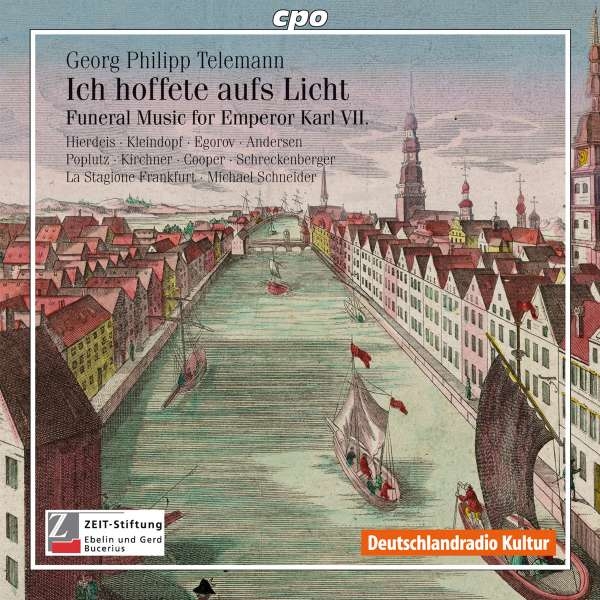
Telemann: Trauermusik für Karl VII TWV4:13 "Ich hoffete aufs Licht"
10,00 €
Formát:
CD
Dostupnosť:
dodacia doba 7-28 dní
Katalógové číslo:
9797998
EAN kód:
761203760329
Autori:
Georg Philipp Telemann
Interpreti:
La Stagione Frankfurt
Vydavateľ:
CPO
Zoznam skladieb
Ich Hoffete Auf Licht Twv 4:13 (Trauermusik Für Kaiser Karl Vii)1
Dictum: Ich hoffete auf Licht (1. Teil)
2
Arie: Muß unsre Hoffnung so zerrinnen?
3
Accompagnato: Warum, o Gott, verwirfst Du uns so gar?
4
Arie: Die auf ihr unbekannten Wellen
5
Rezitativ mit Choral: Uns lässet zwar, o Gott
6
Dictum: Die Güte des Herrn
7
Choral: Herr, wir bekennen es mit unserm Munde
8
Rezitativ: Allein, wie könnten wir bei diesen Ungewittern
9
Arie: Des Zepters, das er führte
10
Accompagnato: O laß dann, großer Gott
11
Arie mit Chor: Lasst uns klagen
12
Accompagnato: Ja! Fahre fort (2. Teil)
13
Dictum: Meine Harfe ist eine Klage worden
14
Rezitativ: Ja, ja! Denn dieses Leid
15
Arie mit Chor: Lasst uns klagen
16
Rezitativ: Dein großer Geist
17
Arie: Melde, gewognes Gerüchte
18
Rezitativ: Sein edles Herz
19
Arie: Aber, wie Winde die Stoppeln zerstreuen
20
Rezitativ: Du bleibst indessen, wie du bist
21
Choral: Wer hofft in Gott und dem vertraut
22
Rezitativ: Ach! aber laß dir einst das Flehen
23
Arie: Wir knieen, o Versöhner, hier
24
Choral: O du Lamm Gottes
25
Dictum: Ach daß müssten zu Schanden
26
Rezitativ: Getrost! du lässest zwar
27
Dictum: Der Herr, der Gott über alles lebendige Fleisch
28
Rezitativ: Auf! wer noch den Verlust
29
Chor: O du Volk vom teutschen Samen
Popis
Telemann’s State Funeral Music
Telemann wrote funeral compositions for many persons. His setting of the Funeral Music for Emperor Charles VII – transmitted solely in the form of a sketch in the composer’s own hand with numerous corrections and writing simplifications and in part without a text – already points to typical features of his late vocal work: a treatment of the vocal parts that is melodically sometimes austere, mostly coloratura-poor, and systematic in its employment of verbal meter, a melodic design sharpened by succinct rhythms and suspensions, and a harmonic structure enriched by pointedly set interdominants. This funerary music is set in the context of the state compositions ordered by the Hamburg city council for the elections, coronations, weddings, and deaths of Holy Roman Emperors of the German Nation. These works were usually performed in churches and sometimes even in liturgical settings and thus represent a special branch in Hamburg church music. The Hamburg city council assigned special importance to the poetic text for the settings. It almost goes without saying that Telemann again, despite the solemn formal occasion, again develops his own very personal musical language that goes straight to the heart.