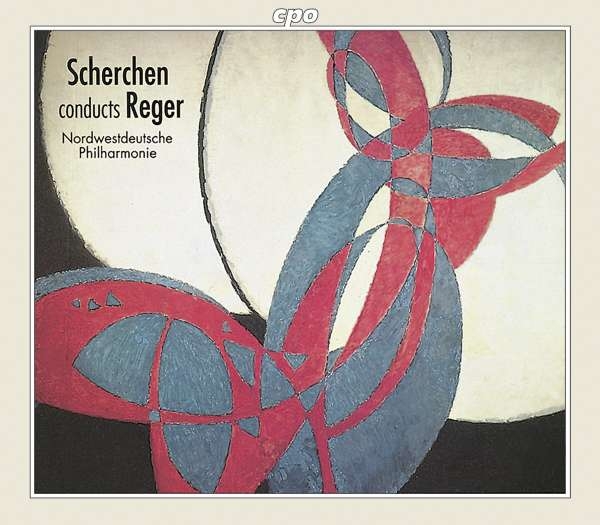
Reger: Hermann Scherchen dirigiert Reger (2CD)
10,00 €
Formát:
CD
Dostupnosť:
7-14 dní
Katalógové číslo:
5972517
EAN kód:
761203914326
Autori:
Max Reger
Interpreti:
Hermann Scherchen, Nordwestdeutsche Philharmonie
Vydavateľ:
CPO
Zoznam skladieb
Disk 1 von 21
Eine Lustspiel-Ouvertüre op. 120
Serenade G-Dur op. 95
2
1. Allegro molto
3
2. Vivace e Burlesca
4
3. Andante semplice
5
4. Allegro con spirito
Eine romantische Suite op. 125
6
1. Notturno: Molto sostenuto
7
2. Scherzo: Vivace
8
3. Finale: Molto sostenuto
Disk 2 von 2
1
An die Hoffnung op. 124 (Kantate)
Variationen und Fuge über ein Thema von Beethoven op. 86 (für Orchester)
2
Thema: Andante
3
Variation 1: Un poco più lento
4
Variation 2: Appassionato
5
Variation 3: Andante grazioso
6
Variation 4: Vivace
7
Variation 5: Andante sostenuto
8
Variation 6: Allegretto con gracia
9
Variation 7: Poco vivace
10
Variation 8: Allegro pomposo
11
Fuge: Con spirito
Variationen und Fuge über ein Thema von Mozart op. 132 (für Orchester)
12
Thema: Andante grazioso
13
Variation 1: L'istesso tempo
14
Variation 2: Poco agitato
15
Variation 3: Con moto
16
Variation 4: Vivace
17
Variation 5: Quasi presto
18
Variation 6: Sostenuto
19
Variation 7: Andante grazioso
20
Variation 8: Molto sostenuto
21
Fuge: Allegretto grazioso
Popis
In Max Reger's extensive compositional oeuvre, which includes 148 counted and well over 100 uncounted works, the compositions for orchestra alone or with the inclusion of the orchestra occupy a comparatively small space; moreover, a glance at a chronological catalogue of works reveals that the composer only began to deal creatively with the means of the orchestra relatively late
In view of the tremendous productivity, which is all the more impressive in view of the short lifespan, the only 32 compositions for orchestra or with orchestral accompaniment are quite modest. It is interesting to note that three quarters of these pieces were written in the last decade of his life - an indication that Reger may have felt that he was mature enough to work with the orchestra only late in his career... He himself said that it was precisely during his time there as General Music Director from 1911 to 1914, when he was dealing with the musicians of the Meininger Hofkapelle, one of the most renowned German orchestras at the time, that it was to his credit to deepen his theoretical knowledge. ... In a letter to his pupil Joseph Haas, who left him even a negligibly small number of orchestral works, Reger writes: "You know: instrumentation - you have to work practically with an orchestra for years, and that's the way I did it!
However, the fact that Reger's orchestration skills were not as poor as his own assessment might suggest, even before the actual Meiningen period, is shown by his Lustspielouvertüre op. 1 20, first performed in Cologne on 7 November 1911. This is a composition that combines the greatest possible temporal density with the greatest possible tonal transparency; it is not known that Reger might have thought of a concrete comedy model that could have been preceded by this overture. He himself called them "ur-urfidel" in a letter, which actually corresponds to the character of the work (and once again underlines the accuracy of Reger's - mostly funny - remarks). Finally, the understatement with regard to one's own orchestral practice is all the more unacceptable with reference to the Serenade op. 95, premiered on 23 October 1906 in Cologne and dedicated to "Felix Mottl in memory of 8 October 1905'" Mottl had conducted the first performance of the Sinfonietta op. 90, but - what Reger perhaps didn't know - in the course of studying the score and rehearsing, he developed an increasingly strong aversion to the piece. The Serenade, which was composed so clearly before the Meiningen period, now shows a mastery in dealing with timbres that does not need to shy away from comparison with colleagues renowned as orchestral composers. The delicacy with which he mixes the sound of two string groups, one of which plays in a silenced manner, and thus achieves truly surprising results, is remarkable. Reger called the Serenade "a most innocent thing, which is so clear that even the stupidest guy has to die immediately". The work is divided into four movements (allegro moderato - Vivace a burlesca - Andante semplice - Allegro con spirito) and, as the composer's comments show, addressed contemporaries directly: "Yesterday evening in Petersburg with Serenade op. 95, which I conducted myself ... enormous success". Both the structure, which follows classical construction principles, and the division into two bodies of sound, a procedure which is to be understood as standing in the tradition of the Baroque and which was applied almost simultaneously by Ralph Vaughan Williams in his Fantasia on a Theme by Thomas Tallis, allow the popularity of the serenade to be comprehended alongside the rather simple, catchy texture - a popularity, however, which over the years has not been able to prevent one from hardly encountering the piece today
in Max Reger's oeuvre there are only two contributions to the genre of programme music so popular at the turn of the century; in addition to the four tone poems for large orchestra after paintings by Arnold Böcklin op. 128, op. 1 25 (recorded here) Eine romantische Suite (nach Eichendorff) from the year 1 91 2 is to be mentioned. The secondary literature rightly refers to the proximity to the works of Claude Debussy; one could even go so far as to describe the romantic suite as "impressionistic". Reger titled the first version of the score "Three orchestral studies: Notturno, Elfenspuk, Helios". (At least the title of the first movement, which he retained, is reminiscent of the comoonist of the Trois Nocturnes, a little constructed might seem more like trying to take the name of the sun god Helios as a reference before the French composer's color-light composition.) Only later did Reger precede the individual movements with Eichendorff poems
As op. 124 Reger also wrote the orchestral song An die Hoffnung for AIt (or mezzo-soprano) in 1912 with orchestral accompaniment on a poem by Friedrich Hölderlin
An die Hoffnung is, besides Hymnus der Liebe op. 136, Reger's only original work for voice and orchestra. In addition, there are twelve orchestrated piano songs, among them the well-known Mariä Wiegenlied aus den Schlichte Weisen op. 76 (Lullaby of the Virgin Mary from the Plain Wise Men, op. 76), which is increasingly detached from the composer. The alto Anna Erler-Schnaudt, who also acted as soloist at the world premiere on 12 October 1912 in Eisenach, is the dedicatee of An die Hoffnung ist die Altistin Anna Erler-Schnaudt. Munich critic Rudolph Louis, whose devastating review of the Sinfonietta op 90 had caused a sensation eight years earlier, wrote on the occasion of the first performance of the song on January 6, 1914: "The ode 'An die Hoffnung' ...whose vocal part was performed splendidly by Mrs. Anna Erler-Schnaudt, also has an effect on the mood and wonderful treatment of the orchestra Reger uses only two woods and trumpets in the score, completely renounces the low brass registers, but nevertheless sets for four horns, which, however, are used so carefully that the audibility of the singing voice is always preserved
One of Reger's last orchestral works was the instrumentation in 1915 of the Variations and Fugue on a Theme by Beethoven op. 86, formerly written for two pianos with four hands, which was already written in 1 904 (he had the Mozart Variations oo. 1 32 for this instrumentation). The fugue from op. 86 was the first example of the later chorale fugues, so typical for the movement, in Hiller and Mozart variations. Out of the original twelve, four variations have been deleted. The musical logic keeps Reger - after all, a pupil of the strict Hugo Biemann - quasi lawfully upright by creating new harmonic connections through transposition. He wrote to his publisher: "This will give you a work of artistic value at least equal to that of my op. 100, the Hiller Variations, but with two major advantages over them: 1. it is much better orchestrated due to my 'Meininger' experience, 2. it is shorter. I have taken such an instrumentation - without a harp - that any city band can do the work" The theme is the Bagatelle op. 119, 11 by Ludwig van Beethoven, which Reger had already developed into an almost symphonic work in the piano version; the instrumentation can therefore only be classified as logical
Reger's unbrokenly most popular - and still the most frequently performed - work is undoubtedly Variations and Fugues on a theme by Mozart, op. 1 32, which demonstrate his mastery of craftsmanship and his grown experience like no other of his orchestral pieces. Seven years before the Mozart Variations, he had already achieved a great success with the aforementioned op. 100, the Variations and Fugue on a Theme by J. A. Hiller. In contrast to his preoccupation with the theme of Rococo minor master Johann Adam Hiller, Reger shows his admiration for the great role model ("Mozart was the greatest musical miracle seen on earth!") already in the cast of op. 132. He writes in a letter: "Think of the splendor of sound of the Mozart Variations op. 132, written without trombones for a really small orchestra! ... The idea alone brings the increase - not any color complexes!"
The variations are based on the theme that Mozart had already varied in his A major Piano Sonata K. 33. 1; Andante grazioso uses the songlike 6/8 theme, which is almost in the Rococo tradition; in the following eight variations Reger increasingly moves away from the original. Joseph Haas: "Parts of the theme emancipate themselves and develop further independently, arbitrary fragments couple together and weave themselves into each other, thematic melody particles appear and disappear in the orchestral waves in order to make way for completely new formations; in short, the imagination leads. and the theme follows, not the other way round