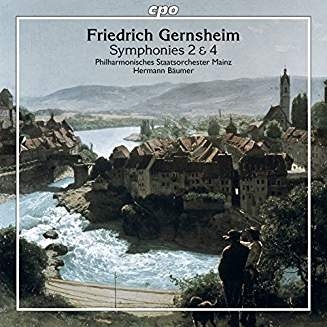
Gernsheim: Symphonies Nos. 2 & 4 / Volume 2
9,00 €
Formát:
CD
Dostupnosť:
7-14 dní
Katalógové číslo:
3126659
EAN kód:
761203784820
Autori:
Friedrich Gernsheim
Interpreti:
Hermann Bäumer, Philharmonisches Staatsorchester Mainz
Vydavateľ:
CPO
Zoznam skladieb
Gernsheim: Symphony No. 2 in E flat, Op. 4629:51
Philharmonisches Staatsorchester Mainz
Hermann Bäumer
I. Allegro tranquillo
11:23
II. Tarantelle: Molto Allegro e con fuoco
4:02
III. Notturno: Andante
6:38
IV. Finale: Poco animato e sempre piu
7:48
Gernsheim: Symphony No. 4 in B flat, Op. 62
30:45
Philharmonisches Staatsorchester Mainz
Hermann Bäumer
I. Allegro
11:27
II. Andante sostenuto
8:28
III. Vivace scherzando e con grazia
2:58
IV. Allegro con spirito e giocoso
7:52
Popis
Following the successful release of the first volume of Gernsheim’s work (Symphonies Nos. 1 and 2) CPO now present volume 2 - Symphonies Nos. 3 and 4. Passages of this new CD suggest a Brahmsian influence, but then the music goes on to develop a different, more original and precisely orchestrated sound. Gernsheim has come to be regarded as one of the important romantic symphonists after Mendelssohn and Schumann and from the era of Bruckner and Brahms. The Symphony op.46 premiered by Gernsheim himself in Rotterdam on 16 March 1882 returns to a compressed musical language. In some passages – and especially in the horn sound of the first movement – it seems to reflect Brahms’s Second Symphony. As a whole, however, this work is a highly individual composition. Gernsheim composed his Fourth and last Symphony op.62 in Berlin in 1895. Of all his symphonies, it is the one that calls for the largest ensemble, with an English horn, bass clarinet, tuba, and cymbals in addition to the usual orchestra of the nineteenth century. In some sections – especially in the first movement – this work creates the impression of a continuation of the Second Symphony while mixing relaxed and orchestrally thinned-out passages with energetic tuttis. Woodwind solos and catchy string cantilenas mark the music here as well; the middle segment (development section) again displays Gernsheim’s excellence as a symphonist. As the musicologist Dietrich Kämper stated in 2002, here Gernsheim exhibits his ‘consummate command of the compositional means’ without ‘artistic sterility’.