 | Jana: Cesta |
 | Dino Saluzzi: El Encuentro |
 | Rigmor Gustafsson: Calling You |
 | Miki N´Doye - Tuki |
 | Flying Colors: Third Degree |
Cartellieri: Die drei Wiener Bläserdivertimenti
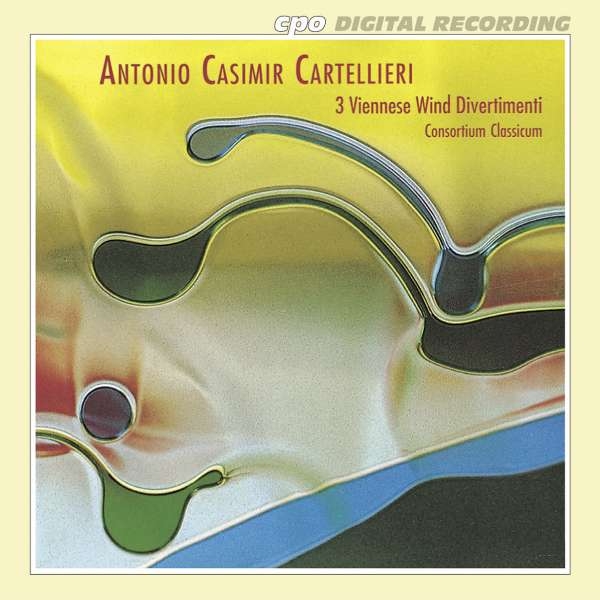
10,00 €
Formát:
CD
Dostupnosť:
dodacia doba 7-28 dní
Katalógové číslo:
5954919
EAN kód:
761203914029
Autori:
Antonio Casimir Cartellieri
Interpreti:
Consortium Classicum
Vydavateľ:
CPO
Zoznam skladieb
Divertimento für 2 Oboen, 2 Klarinetten, 2 Hörner, 2 Fagotte und Kontrabass Nr. 1 F-Dur1
1. Allegro
2
2. Romance
3
3. Menuetto: Allegro di molto
4
4. Andante con variazione: Poco adagio
5
5. Finale: Presto assai
Divertimento für 2 Oboen, 2 Klarinetten, 2 Hörner, 2 Fagotte und Kontrabass Nr. 2 F-Dur
6
1. Adagio - Allegro agitato
7
2. Adagio poco andante
8
3. Menuetto
9
4. Alla cosacca
Divertimento für 2 Oboen, 2 Klarinetten, 2 Hörner, 2 Fagotte und Kontrabass Nr. 3 F-Dur
10
1. Allegro
11
2. Andante con variazione
12
3. Menuetto: Presto
13
4. Finale: Allegro
Popis
Antonio Casimir Cartellieri - born on 27 September 1772 in Gdansk and died on 2 September 1807 in Liebshausen / Bohemia -, was already early in the parental home of his mother Elisabeth and the father Giuseppe Cartellieri musically trained.
The marriage of the parents was very shattered and finally her divorce led to it, that Antonio Casimir was already with thirteen Years of seeking independence and that the I left my parents' house. After a time of "musical "He was wandering around 1791 as music director and court composer at Count Oborsky's, and as his Companion led him his way 1792 to Berlin. Here he was given his first successes as a dramatic composer. Its restless Spirit - created by the parental Disproportion - let him in the Prussian Not to gain a foothold in the capital, but rather to it took him to the "Metropolis of Music" after Vienna, where he studied with the greatest Music teachers of his time, Albrechtsberger and Salieri, searched and found.
Quickly the musical world became Vienna's attention to the young genius, and a recommendation brought him 1796 the highly sought-after Kapellmeister post with Prince Lobkowitz, who in winter took his stay in Vienna and during the of the summer months on his estates and castles in Raudnitz and Eisenberg resided. Until early death, Cartellieri remained to the Princely House in this demanding Position artistic and and I've been friends for a long time. Similar to Joseph Haydn in front of him on his inauguration
i
n Esterhazy, developed also Cartellieri a remarkable composition activity here,
that I was
attracted to
, later on to amaze even Beethoven.
The first nineties of the at the end of the 18th century also the acquaintance to this. Whether the Contact in Vienna or Bohemia is no longer exactly ascertainable. Fact is that the almost peerless young Musicians friendly contact and a lot of things that we later learned at the Beethoven as so typically moved, has its origin in this time and at Cartellieri. As an example here may be Cartellieris Oratorio "Gioas" shall apply, at its performance on 30 March 1795 (so even before his employment as Kapellmeister) Beethoven first
public in Vienna as a pianist.
Theophil Antonicek wrote about it and about Cartellieri in general the following very relevant sentences: "Cartellieri shows in his overture quite remarkable Parallels to works of the first Beethoven's creative period, especially for the 1. Symphony! Not only are there Beethoven's characteristics such as pathetic Minor points ..., vigorously pushing forward Rhythmics, Sequenzsteigerungen Orchestra- Unisoni and masterly grinder figures, but also in the themes of the Allegro sets a clear thematic appeal, which is transferred to the Il. In both cases the second stage is still emphasized. lm With regard to the biographical and obvious stylistic proximity to Beethoven appears an occupation
with Cartellieri worth the trouble."
How right Antonicek was when he wrote these words was not yet clear to his generation of musicians, because to this day there is no record release of this "genius" who, due to oppressed personal relationships and a not full to short life (in the Beethovenian Senses) could unfold. The "Three Wiener Bläserdivertimenti" for 2 Oboes, 2 Clarinets, 2 corni, 2 bassoons and double bass (probably between 1792-1794 for the imperial harmony music) in at a time when Cartellieri was making an effort, to make closer contact with Beethoven. Beethoven had just had experience with "Harmoniemusik". The Compositions of his "Bonner Werke" for Wind ensemble (octet, rondino, quintet fragment, Sextet?, Duos...) were still fresh in your mind. Beethoven set great store by
that
these pieces will also be performed in
Vienna were performed.
Once we've critically examined Beethoven's Wind Works and the Cartellieris compare, so are many similarities to determine. You can see, though, that from 1795 on at the latest the intellectual The paths of the two young talents separate. Whereas Beethoven's the path we have chosen continues to grow personalized and finally unmistakable cartellieri has a rather versatile orientation. He's a searching ghost! Haydn as Father of all classical things sounds through, Beethoven is already here, themes Schubertscher coinage are invented and point the way to the future
a
lmost completely unnoticed clarinet concertos he even became
Mendelssohn's
forerunner
.
Early death didn't give him time, to form a final personal style, as it would be for the 20 year old Beethoven or even Haydn. Mozart is in this context like a miracle that people have only once in an epoch of art. Finally i would like to point out that Cartellieri with his Divertimenti wind chamber music which was due to the above described Strengthen a comparison to the Beethoven's creations for harmony music resist, yes, in some details even outstrip them. The high technical Requirements for all instrument pairs may be mentioned here on the side be. A certain inappropriateness for the sake of this music with its great dramatic increases leads to all groups - even with today's instruments - into adventurous areas (horn parts
).
unlike his parents' marriage, casimir Antonio Cartellieri introduced happy family life with his wife Franziska (a daughter of the famous cellist and composer Anton Kraft, who as a Haydn's friend under this one in the Esterhazyschen Court chapel in Eisenstadt) and his three sons Joseph, Paul and Anton. Joseph Cartellieri was born after the Deaths of father his successor in office "at the Lobkowitz" and retained this position until his death in November 1820. From the family that still exists today later some went to the most different Areas remarkable personalities of public life.