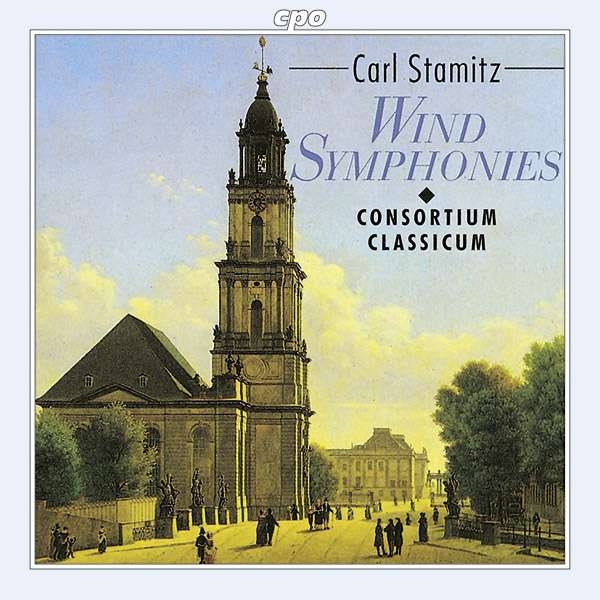
Stamitz: Wind Symphonies
8,00 €
Formát:
CD
Dostupnosť:
na sklade / in stock
Katalógové číslo:
5218774
EAN kód:
761203908127
Autori:
Carl Stamitz
Interpreti:
Consortium Classicum
Vydavateľ:
CPO
Zoznam skladieb
Partita für Bläser Nr. 1 H-Dur1
1. Allegro assai
2
2. Andante moderato
3
3. Allegro assai
Oktett für Bläser Nr. 1 H-Dur
4
1. Allegro
5
2. Andantino
6
3. Menuetto
7
4. Rondeau: Allegro
Partita für Bläser Es-Dur
8
1. Allegro
9
2. Allegro assai
10
3. Largo
11
4. Menuetto
12
5. Allegro assai
Oktett für Bläser Nr. 2 Es-Dur
13
1. Allegro ma non tanto
14
2. Allegretto
15
3. Menuetto
16
4. Rondeau: Allegretto
Oktett für Bläser Nr. 2 H-Dur
17
1. Allegro con spirito
18
2. Andantino
19
3. Rondo: Presto
Popis
One can only marvel again and again at how carelessly musician about epochal events pass away like for example in the case of Johann Wenzel, Anton and Carl Philipp Stamitz, the Founding and consolidating the so-called "Mannheimer School. In fact, the father and son Stamitz by their contemporaries as ingenious Innovators, instrumentalists and composers, while these days the Name Stamitz rather something for competitions how "youth makes music" is and in dilettante circles in honor of what for a good instinct unspent Tempers speaks. The merits of the two To introduce an artist cannot be a goal of a record release. Numerous scientific studies have the historical value of their Compositions and the personalities of the in detail. The result of Stamitz's efforts - the "Mannheim Orchestra" christian F D. Schubaft was allowed to perform with enthusiastic Lines by adding wrote
"No orchestra in the world has done it each in the version of the Mannheimer done before... his forte is a thunder, his crescendo a cataract, his diminuendo a rippling into the distance Krystallfluss, his piano a spring breeze". Schubart's words were often quoted, but seldom a consequence of it as the Mannheimer School in today's music life may be considered passé. Some experiments of the D. G. Archive production years ago, Mannheim
composers to the market have gone astray.
Men like Mozart and Havdn would have without the groundbreaking developments of the family Stamitz and Philipp Emanuel Bach harder. After Leopold Mozart was the Mannheim orchestra "the best in Germany". From J. Stamitz as composers it was called: "His genius was very original, bold and powerful. Invention, fire and contrast in the fades Sentences, tender, charming and flattering melody in the slow, associated with ingenuity and Characterize Wealth in Accompaniment his works" All are of a strong Expression, which is the enthusiasm
of
the genius and
the Culture without suppressing it". (Burney)
It can be said that the Stamitz family created an unmistakable handwriting. Son Carl of the Bohemian emigrant Johann grew up musically in the Hofkapelle his hometown Mannheim on the and received his first lessons from his father
a
nd after his death from cannabis, Holzbauer and Richter. As early as 1762 he is a member of the Mannheim Orchestra, where he played second fiddle until 1770
p
layed. A certain duplicity to Leopold Mozart and Wolfgang Amadeus Mozart is to be found when you look at the life by Johann and Carl Stamitz. Both equal is a highly gifted father, who is a more ingenious Son who was brought up by restless Driven on numerous travels as a "European musician" with his health And the exploitation of the land. Carl was a "Fiery" spirit! Already in 1770 he retired from electoral Palatine services and went to Paris to see the Duke
L
ouis von Noailles, who also made him a court composer
a
ppointed. His compositions and his appearance in the "Concerts Spirituells" were not without Influence on the young - in new ways searching - generation of composers France. In 1773 we find him in Frankfurt and 1774 in Augsburg and Strasbourg again. In the years 1777 and in 1778 he had great success in London (Emperor). But here, too, he was able the music life does not give anything new and he turned to the Netherlands in 1782. where he was in The Hague and Amsterdam
c
oncert. Returned to Germany in 1785, he stepped mainly in Northern Germany, namely in Hamburg, Lübeck, Brunswick, Magdeburg and Leipzig and then 17BO to Berlin
w
here he was a violin soloist
I
made speeches. This visit to Berlin had a drastic effect on the the life of the gifted Stamitz. One under a treaty that no longer exists, was given to him by the Prussian king assures that "any composition" which is he sent to court, paid by the king
w
as. Despite this honorable distinction
s
tamitz did not hold it in the prussian capital. He turned in 1787 to the Principality of Hohenlohe, where the he was said to have been the bandleader, which, however, cannot be substantiated. But again this year, he was grabbed the wanderlust and it led him to Dresden, Prague, Halle and Nuremberg, later to Mecklenburg-Pig and back via Eutin to Ottingen-Wallerstein into a court chapel, the Mannheimer Orchestra almost equal. In winter
1
7$gl90 he then headed the lovers Concerts in Kassel and lived afterwards in in the Vogtland. Sick, burnt out and tired of traveling, he applied without success as Kapellmeister at Schweriner Court (emperor). How much to Stamitz here, shows that still today with archive of his compositions, where I do many studies for this CD was allowed to. On 12 November 1792 he most probably met in Weimar with Goethe together, when he was a great At the court theater. Subsequently his way led him once more to Mannheim, but then, when he was in his hometown no longer succeeds
s
ettled in Jena in early 1795. From at this point in time his Project in the dark. Of great composition plans is handed down to us and of attempts at gold making. Further Travel is not known. Fact is that Carl Stamitz has a wide variety of Style characteristics of contemporaries and regions and took her in so much as she could
h
appily assimilated that he was given an to grant a pronounced personnel style may . Unfortunately, to this day
h
is average compositions has become known. This undoubtedly includes also some overworked brass concerts, that is known as "wrist exercises." the burden on posterity. Of his true and bold Creations, where he is completely in the spirit of the And in many ways he has been a great Mozart and
Haydn
shared
equally nothing became popular.
This also includes its numerous Blower parthia, which until now have been considered lost
a
nd which I had to use on my travels through the United States, into the CSSR, USSR, but also in Scandinavia, Southern Germany and rediscover Austria was allowed to. It was a tedious undertaking, to investigate these works. Level because Reiselust Stamitz through half of Europe and the compositional traces of the often lost in the smallest archives. Although belonging to the class of "Divertimentomusic", we can find in the Blower parthia much of what we have seen at Haydn and Mozart so excited. It's but completely wrong to send his works to the Compositions of these masters. Undoubtedly here at Carl ("Man of Bohemian Blood"), a compositional confession, which is a glimpse into his artistic soul. Scholarly thinking and musicianship shake hands. You could of a happy synthesis by Philipp Emanuel Bach, Mozart and Haydn i'd like to talk to you. But to
a very own and an original way.
His E flat major Parthia is a part of a Composition cycle, the headquarters to the King of Prussia, and for the he probably also - as contractually assured
- a handsome fee.
We have come from the numerous Parthias for the No. 1, who with her wonderful slow C minor The first movement penetrates into Mozartian worlds, whereby this statement is once again erroneous, because these are original Stamitzsches Thought. But who would measure doesn't like Mozart? The corner sets are symphonic in nature, just like she
composed Haydn at
about
the same time.
in the octet in B flat major No. 1
r
emembers the master of the Esterhazy period with a wistful three-four time signature, to think about Mozar a little while later, if Stamitz in the slow record the Theme of the E flat major symphony
.
Courtly music was also hunting music. Savoury to see Stamitz in his brass sextet undermining conventions, by not attaching the hunting sentence to the But to the beginning of the divertimento
t
he one who's gonna be
A sentence, with large Sound effects in order to achieve the Listener to a composition to be taken seriously to prepare. Sounding from afar Horn signals, slowly approaching in three stages, documenting this. In the slow sentence
S
tamitz, however, other tones on with wonderful cantabile places and surprising harmonic twists. A haydnsches minuet presides over it a sparkling Rondo alla Christian Bach. His Octet in E-flat Major No. 2 begins with a expansive octave jump of the clarinet, accompanied by exciting sixteenths in the second voice. The completely symphonic first movement makes you forget the Divertimento and leads into the world of Bohemian symphonists krommer
or Kozeluch.
But let us come to the main work of our CD, the great B'Major Octet No. 2. We were strange at the recording
w
e were able to create the work stylistically in his entire oeuvre. Here a musician reveals himself, that reaches far into romance. Please note You, dear music listeners
T
he development of the first movement, where he wrote thematic complexes that later typical of Mendelssohn. The slow movement, a notturno, born of the best Bohemian tradition, captivates through sentimental thematic Inspirations and interesting harmonious Returns. Did he now Did you know Haydn's London Symphonies? You might think so. Or is it the other way around? Did Haydn Stamitz go to college? In any case, his last sentence reminds me to relevant works from Haydn's London "Reprise," his second trip to England
1
794, whereby Stamitz still another remaining by adding to the first clarinet a virtuosity, as it was only in the of romanticism many years later usual was. Remaining to state that the minimization of his work with the Trademark "Mannheim School" and the stamp as a "little master" have led to the fact that his Oeuvre of performers - I don't talk from musicology - never serious was examined. I have numerous Works in which Stamitz is widely known
g
oes beyond what is commonly known as a
expected from
a Mannheim musician
.
Finally, I would like to make the following remark allows us to use our publication no representative selection of its Chamber music. Rather we have taken from the rich Heirs who are currently the most accessible to us Works selected, whereby is clear, that further highly interesting finds have been discovered are expecting. Maybe this CD is the right one
t
hat musician and audience in the future more attentive his creations look at it.