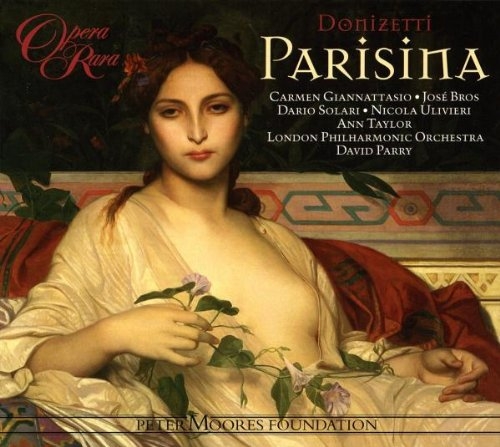
Donizetti: Parisina (3CD)
49,90 €
Formát:
CD
Dostupnosť:
backorder / dodacia doba 10-28 dní
Katalógové číslo:
ORC40
EAN kód:
792938004020
Autori:
Gaetano Donizetti
Interpreti:
David Parry, London Philharmonic Orchestra
Vydavateľ:
OPERA RARA
Zoznam skladieb
Donizetti: Parisina d’estecast:
Carmen Giannattasio (Parisina), José Bros (Ugo), Dario Solari (Azzo), Nicola Ulivieri (Ernesto), Ann Taylor (Imelda)
Geoffrey Mitchell Choir & London Philharmonic Orchestra, David Parry
Popis
‘Carmen Giannattasio’s last gasp was one of the most electrifying in all opera' Hilary Finch, The Times, reviewing Opera Rara’s concert performance.
Donizetti’s gripping opera Parisina comes from a particularly fruitful period in the composer’s output. It was premiered in Florence in 1833, the year that Lucrezia Borgia opened at La Scala and Torquato Tasso in Rome, with a libretto by the leading exponent of the craft at that time, Felice Romani. And yet the opera is rarely performed today – even though it was widely staged during the two decades following its premiere. Its fortunes may change again with this new recording, cast from strength and led by the Parisina of Carmen Giannattasio (heard in La donna del lago – ORC34) and José Bros (heard in Roberto Devereux – ORC24) as Ugo. The plot is unusually dark, even for an early romantic melodramma. Parisina, the wife of Azzo, a 15th-century Duke of Ferrara, has fallen in love with Ugo, who turns out to be a child of Azzo’s previous marriage.
In furious anger at her outlandish passion, Azzo has his own son murdered, and presents his anguished stepmother with the corpse. This horrifying scenario was just the sort of passionate narrative to set the composer’s musical pulses racing, and the result remained his favourite among his works for many years; as his biographer William Ashbrook has written, ‘Parisina contains some of Donizetti’s most vivid musical portraiture.’
The 3CD set comes with a lavishly illustrated book including a complete libretto with an English translation. Article and synopsis by the eminent 19th century musical scholar, Jeremy Commons.