




Košík
Váš košík je momentálne prázdny.
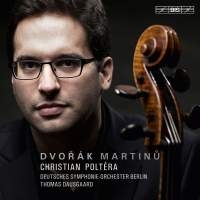
Dvořák & Martinu: Cello Concertos (SACD)
17,90 €
Formát:
SACD
Dostupnosť:
dodacia doba 7-28 dní
Katalógové číslo:
BIS2157
EAN kód:
7318599921570
Autori:
Antonín Dvořák, Bohuslav Martinů
Interpreti:
Christian Poltéra , Deutsches Symphonie-Orchester Berlin, Thomas Dausgaard
Vydavateľ:
BIS
Zoznam skladieb
Dvorak:Cello Concerto in B minor, Op. 104
Martinu:
Cello Concerto No. 1, H.196
3rd version
Christian Poltéra (cello)
2016 (Hybrid SACD)
Popis
Since 2007, cellist Christian Poltéra has recorded a number of acclaimed discs for BIS, of less often heard concertos by composers such as Othmar Schoeck, Frank Martin and Samuel Barber, as well as contemporary classics including Henri Dutilleux’s ‘Toute un monde lointain…’. Across the world, reviewers have been bowled over by Poltéra’s effortless technique, but even more so by his communicative skills and beautiful sound, typically using adjectives such as ‘glowing’, ‘lyrical’, ‘ripe’ and ‘singing’. These are of course qualities that will enhance any repertoire, and here, on his latest disc, Poltéra has occasion to apply them to one of the truly great Romantic concertos. Antonín Dvořák once famously expressed the opinion that the cello was unsuitable as a solo instrument, going on to compose what was to become one of the most beautiful, as well as popular, concertos in the repertoire. Although the solo part is demanding, the work is by no means a bravura showpiece. Instead, the orchestra and soloist form an integral whole, something which is admirably brought out in the interaction between Poltéra and the Deutsches Symphonie-Orchester Berlin under Thomas Dausgaard. When he composed his First Cello Concerto, in 1930, Dvořák’s compatriot Bohuslav Martinů also wanted to create a work involving dialogue between soloist and orchestra. Inspired by the concerto grosso form of the baroque era, he wrote a first version for cello and chamber orchestra, which he revisited in 1939, expanding it for large orchestra. In 1955 he returned to the concerto once again to create a third and final version, which has become one of his most popular works.Prihlásenie
Newsletter


Copyright 2014-2026 © Hummel Music